


Ben is a self-taught developer and restless thinker who chose the nomad path over a conventional Australian life of cars, houses, and boats. After a long-term relationship collapsed, he rebuilt himself from scratch — learning Bahasa Indonesia to escape Western cultural bubbles, ditching Tinder for a methodical courtship approach, and trading vague life goals for daily non-negotiable practices. Hear how he turned being a 'loser at home' into strong roots abroad.
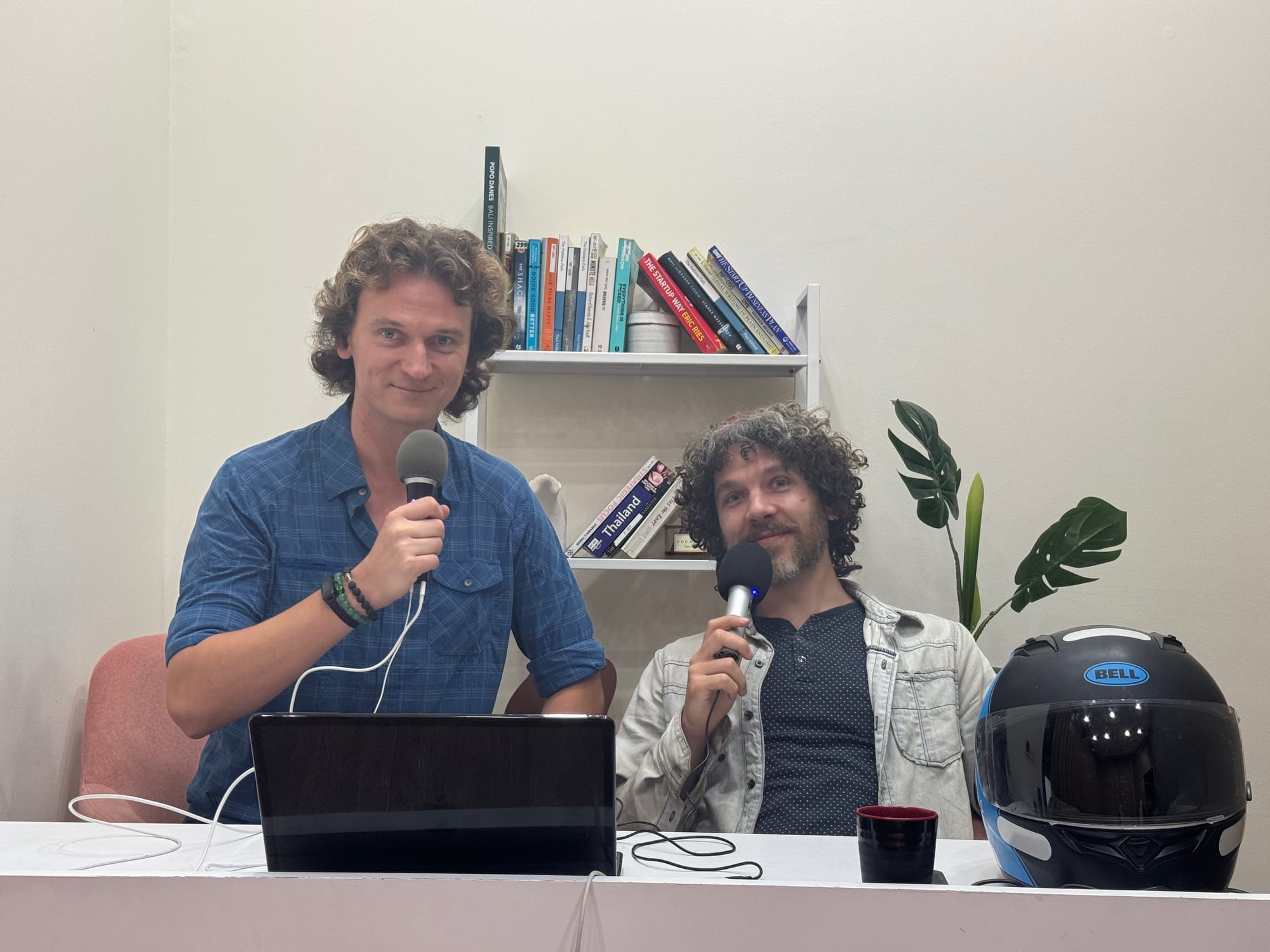
Who is Ben Lupton?
Benjamin, or Ben, is an open-source developer whose work has powered tools at Basecamp, Spotify, Microsoft, Adobe, and Atlassian. He sits in the top 10% of helpers on StackOverflow for JavaScript, Node.js, and related technologies, and holds the rank of 4th most-watched developer in Australia on GitHub. He has traded a conventional Australian career for a life built on daily practices — logging over 2,000 km by motorbike across Bali and beyond, learning Bahasa Indonesia to experience the culture far beyond its tourist surface, and applying his philosophy of sustainable, scalable living to everything from fitness to relationships.
Notes and links
Places
Canggu — the hub of digital nomad life in Bali where the episode was recorded in person.
Mentioned People
Jane Austen — mentioned in the context of the Indonesian word bagus (good), which literally means "obliging" or "agreeable", mirroring Austen's usage of the word.
Bloc Party — "The Prayer" — the song Ben was trying to recall (he called the band "Block Party"), which he interpreted as a prayer from one's future self to one's past self to build good habits and protect what lies ahead.
Alfred Kinsey — American sexologist who led the sexual revolution, mentioned by Ben when discussing how to introduce sexual education into conservative Muslim-majority Indonesia without causing harm.
Stanley Milgram — social psychologist whose obedience experiments revealed how ordinary people comply with authority even against their own conscience — Ben references a documentary about him.
Marcel Proust — French author Ben references for his exploration of poor communication and the person-persona divide in relationships.

Concepts and Language
Bahasa Indonesia — one of the world's youngest national languages, standardized less than 100 years ago to unify thousands of islands.
Hati-hati — Indonesian word for "be careful", literally meaning "liver-liver" — Ben's explanation of how the liver (not the heart) represents the soul in Southeast Asian culture.
Mata Hari — the Dutch-Indonesian name meaning "eye of the day", i.e. the sun (mata = source/spring, hari = day).
Zeitgeist — German concept for "spirit of the time", used by Piotrek as an example of untranslatable words that carry deeper meaning than their literal translation.
Fluent Forever — the language-learning book by Gabriel Wyner that Ben and Piotrek were trying to recall, with the subtitle "How to Learn Any Language Fast and Never Forget It".
Courtship — the deliberate, slower approach to finding a partner that Ben applied, as opposed to modern instant-swipe dating.
Oxytocin — the bonding hormone Ben references when warning against rushing into romance and becoming "addicted" to a partner before establishing shared values.
Polyamory — relationship structure Ben argues is not sustainable for civilization-building, as it promotes intra-gender competition rather than cooperation.
Aikido — Japanese martial art Piotrek practiced as a teenager, connecting its Zen philosophy of daily practice (the path is the goal) to Ben's practice-over-tasks approach.
Trichotillomania — compulsive hair-pulling disorder linked to anxiety; Ben shares that he suffered from this from age 8 until around 2020, framing it as a marker of how far he has come.
Self-governance — Ben's concept that distinguishes governing your behaviour during low-discipline moments from simply demanding constant self-discipline.
Person-persona divide — the philosophical concept Ben uses to explain how we build fixed mental images of people (personas) instead of engaging with the ever-evolving real person.
In Search of Lost Time — Proust's monumental seven-volume novel (also known as Remembrance of Things Past) that Ben describes as "one hell of a tragedy" about miscommunication in relationships.
Freedom of religion in Indonesia — Indonesia officially recognizes only six religions (Islam, Protestantism, Catholicism, Hinduism, Buddhism, Confucianism); atheism is not a legal option. The religion is stated on Indonesian ID cards.
International Driving Permit — required alongside your home-country motorbike licence to legally ride a scooter in Indonesia.
Ben's "A Purpose of Humanities" — a YouTube video Ben recorded in December 2022 in which he laid out his philosophy and goals, and where he describes crying on camera saying "I am a broken person starting from nothing" — mentioned as a personal turning point.
Movies
A Brighter Summer Day (1991) — Ben's favourite Taiwanese film by Edward Yang, nearly four hours long, rated 100% on Rotten Tomatoes.
Obedience (1962) — Stanley Milgram's own documentary film about his famous shock-obedience experiment at Yale University.
Apps and Technology
Claude by Anthropic — AI tool Ben recommends for learning Indonesian etymology and language roots.
Tinder — dating app Ben tried for one week and abandoned, finding it incompatible with his goal of finding a long-term partner.
OkCupid — values-based dating app Ben used successfully, owned by the same parent company as Tinder (Match Group) but with a question-based compatibility system.
Grab — dominant ride-hailing and delivery app in Southeast Asia, which Ben credits with helping modernize Bali's informal transport economy.
Learning Equality — non-profit Ben is working with to bring offline educational access to underserved communities in Indonesia.
Kolibri — open-source offline-first learning platform by Learning Equality (referred to as "Calibri" in the conversation) that runs on low-cost hardware like a Raspberry Pi and provides access to Khan Academy, Wikipedia, and more.
Khan Academy — free educational platform available through Kolibri in offline environments.
Project Gutenberg — free repository of public domain books, mentioned by Ben as content that can be deployed offline for communities without internet access.
Raspberry Pi — low-cost single-board computer Ben mentions as a way to run Kolibri in schools with limited infrastructure.
Ben's Coda Packs — Ben's open-source marketplace plugins for Coda, which generate passive income and are a key part of his scalable work model.
Bevry — Ben's open-source community and umbrella of projects, which he put on hold in 2023 to focus on new directions.
Transcript
Benjamin Lupton 0:00
If I was just opening myself up again to the world because the prior long-term relationship failed. I'm a broken person starting from nothing. This will be my journey to prove that I can do and share something that is of value. And then everything worked out. I found like a routine and a philosophy that provides integrity, like strong roots to build upon.
Piotrek Bodera 0:25
All episodes of this podcast are available for free. And to listen more, I encourage you to subscribe on your preferred podcast app. nerdontour.net is a specialized blog designed for digital nomads. Combining the best bits of the internet, long-term traveling, and decentralization. Support the show by using Nerd On Tour services and recommendations at nerdontour.net. And now, let's start the show.
Hello, Ben. Hello, Piotrek. Welcome to the second episode of Nerd On Tour Podcast.
Benjamin Lupton 1:01
Happy to be here.
Piotrek Bodera 1:04
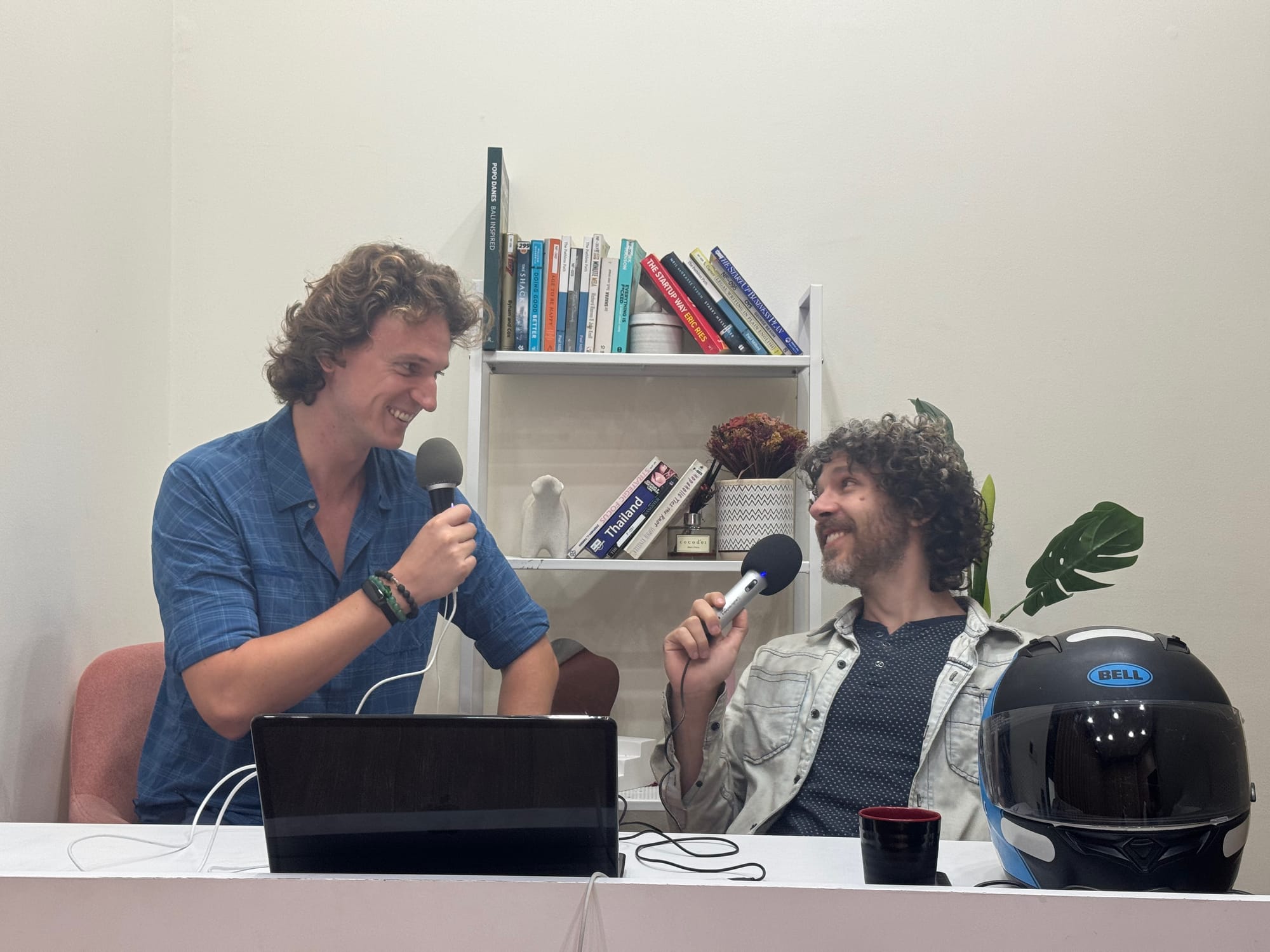
I'm glad that we had a chance this time to do this in person here in Bali, in Canggu. This is true. First time in person. Yeah, yeah. I mean, like we saw each other in person before. This is the first time that we are recording in a nice, proper podcast studio in a co-working here in Canggu. So, I would love to start from the part of the heck of a challenge. I would love to start from the part about learning languages because, for me, it's never-ending adventure and it's something that I have always a challenge with. How it is for you with Bahasa Indonesia?
Benjamin Lupton 1:40
Yes, it comes from the person who already speaks multiple languages and is speaking his second language right now.
Piotrek Bodera 1:48
Okay, fair enough. Still, I consider English at this point as my first language because I've been using it so much. But other languages like Spanish or Portuguese that I'm learning are not coming so easily as English. And in your case, you decided to dive deep into the Bahasa Indonesia, the Indonesian language. So, how it is for you? Yeah, betul betul, which is exactly...
Benjamin Lupton 2:13
I spent so much time there. So, originally, I was just like, I want to learn languages that are antagonistic or rather contrary to English to absorb foreign cultures or alien cultures. Because if you're something Western-aligned, you're going to be getting only content that is Western-aligned and the Western propaganda. And I don't mean like propaganda just in like the CIA ops and things like They just mean propaganda in terms of which ideas are propagating and different cultures will have different ideas based on different principles and values. So, initially, I wanted to either learn Russian or Chinese, but then they're very ambitious and I have no plans to live in either country. So, instead, I was like, okay, well, which countries have I spent the most time in and actually foresee spending more time in? And based on my location in Australia, its geography being next to Malaysia and Indonesia, which is like America's Mexico, I chose to go all in on Indonesian. And again, it turns out to be very rewarding and also fulfills my goals, which is they're also contrary to Western propaganda, I should say. They are absorbing some Western culture, but they still have a very independent identity.
Piotrek Bodera 3:26
Why would you think that Russian or Chinese are the languages to pick, considering that they are also very heavily influenced by the propaganda of the culture and the political systems of the two countries? Right.
Benjamin Lupton 3:42
During COVID, there was a lot of propaganda in Australia. Australia had like some of the heaviest lockdowns possible for COVID. And in our prior podcast, we did talk about how Australia respects like civil disobedience and things. But then it became clear that's not true. If you protested the lockdowns, oh, my God, goodbye, freedoms. And you would have peaceful protests suddenly being beaten and whatnot. So, that was kind of shocking. And then there was also the Russian war or the Russian invasion or special operation of Ukraine, depending on which side you want to believe or take. But I mean, there was the narrative from the West and then there was the narrative from Russia and they were completely contradictory. Like there's no way to resolve them. And yet, if I listen to the Russia stuff, their one actually made sense compared to the Western one, which was completely unprovoked. And then you listen to the Russian one, I was like, oh, no, it's kind of provoked. So, that's why I was very interested. And then also attending, I watch a lot of international films, so it also broadened my cultural awareness and diversity even within myself. And I love Chinese films, especially from Taiwan. They're amazing. They're film great. One of my favorite films, A Brighter Summer Day. It's like four hours long. Brilliant film. And also, yeah, they just seem like to be good places to learn. So, I became more aware of their contrary nature to the Western world and I want to broaden the knowledge that I would receive.
Piotrek Bodera 5:13
Okay. I also try to pick the different sources to get like a better picture of a situation. But it's quite hard, yeah? Like if you're limiting yourself to English because of the West of how powerful they are and they seem to be speaking the same language. Whatever you pick, British or American or Australian. So, let's not dive too much into the politics and like what happened, what didn't happen, you know, in the last few years in terms of those tensions and conflicts. I'm much more interested in the scope of the traveling in Bali and Indonesia at large. But before we go there, you knowing the language really helped you with your unique approach to dating. And they really would like for you to list what did you do that is, again, contrarian to like the, you know, general public, how they are using online dating apps. And what you did and, you know, successfully you found a partner with your method.
Benjamin Lupton 6:15
Yeah. So, just to go back a bit to follow on the language learning and the travel. Before, not knowing a language, you're really limited to just like the tourist experience of a country or a culture. But then when you learn the language, suddenly you can have basic conversations, right? You're never going to have an expert conversation for the second language. Or you adopt it as your mother tongue like Piotrek has done with English, right? So, doing that, then suddenly like I became actually more trustful and actually more impassioned by Indonesian and Indonesian culture. As I learned more about the language, you discover more of its quirks. For instance, there's a lot of symbolic translations that are different from the literal translations. So, for instance, hearty, hearty, which they use for careful, is more like remindful. Be remindful or compose yourself. Because hearty actually means liver. So, when you say hearty, hearty, you're saying liver, liver. But in Southeast Asian culture, generally the liver is where your soul is. Your heart is where your personality is. So, when you start to say like hearty more or like liver you, then it can roughly translate to like love you. Obviously, the proper word for love is going to be chintamol. So, love you is chintamol. But you have these different ones. So, like bike is another great example where bike means symbolically good. But it actually means agreeable or obliging. If you go read like a Jane Austen book where it'll be like, oh, you're so obliging. Oh, how obliging. Right? So, it goes to the value where a good day is a day that was obliging to you. Right? It was a day that was agreeable to you. So, when you say spike, bike, it means like, yeah, today was agreeable to me. Which is like the better translation. And bagus is then like good quality. There's all these different ones. Matamata is your eyes. But mata means spring or like source. So, mata-hari is the sun. And hari is day. So, the source of the day is the sun. Right? So, you have all these interesting quirks of the language that you discover. And it reveals like their philosophy or the principles or the values of the culture.
Piotrek Bodera 8:23
Yeah. Yeah. Totally. Like in every language, yeah, you will find those little words that have meaning and the etymology that tells you so much more. Right. And the moment you understand the concept and there is a lot of those things that are directly incorporated, yeah? Like from German into English and we have zeitgeist. Yeah. Like we don't say the ghost of time because it doesn't really feel the same way as just saying this concept from German that really captures the moment. Yeah. That we can say that the zeitgeist of the 90s, yeah? Was this and that. Would you like to regularly receive intriguing content like this? Subscribe to Nomad Tuesday.
It's nice to hear that in Indonesia you also got to this level that you're comfortable seeing Hadi Hadi. Like we have here a lot of roadworks. And I saw, yeah, that caution, yeah, watch out. And then I remember what you just told me about the heart, the liver.
Benjamin Lupton 9:38
Yeah. So now I feel like I'm getting scammed less. Obviously, if you're looking like a bully. And it's funny, generally I don't get scammed at all in Indonesia because I fit right in. But then I did buy like some bully style shirts which say Bali and the typical tourism thing. And as soon as I put them on, everyone wants to scare me again. But not everyone. I mean, like there's a certain personality of asshole that exists in any country. And the more savvy as a digital nomad you are, the less interactions you have. But just for learning a language, Anthropix Claude is fantastic. It can give you the etymologies. And that'll really help learning a language such as Indonesian, which is a very new language. Because it was invented maybe less than 100 years ago to unify all the different islands. You have a new language and it has words from Indonesian and English. But like it's also another one because they naturalize everything unlike Malay. Where Malay information will be information and Indonesian will be informasi. Yeah. So Claude, a fantastic resource for learning it. And there's also a book which is like how to learn a language or something like that. To learn the smart way for learning a language because before I always struggled. For dating, what I did was originally I did Tinder because everyone knows Tinder. And I did it for a week. And after like swiping for like a few hours and just in Australia and just being exposed to thousands of women in bikinis and alcohol, I decided this is not for me. I'm not going to find my marriage partner for family here. Instead, I looked into the other options. I remembered one called OkCupid from a very long time ago. I used it when I was a teenager as well, which is a long time ago for both me and Peter Jack. But yeah, and then with that one, you answer questions instead. And some of the questions are absolutely stupid. They're only applicable if you are a teenager. Like, would you date someone who claps when the plane lands? Who cares? Right? That's a teenage style question. Right? But then other ones, like... What did you answer? I was just like, skip. Right? I don't care. But yeah, other ones are going to be like, you know, how many children do you have? Things that are getting to the values. Some are actually logical questions, which will be like, if this happened and then that happened and then this happened, what is the answer? And then, like, that's a good filter for intelligence. And then I have one which is like, if you answered different to me, please don't contact me.
But the difference is like, I did a profile where I go very specifically into the courting rather than dating approach because I'm looking for a match partner and I don't want to waste my time. And I also want to avoid all the pitfalls of my prior relationships, in which case I operated either on chemistry or, you know, future goals or, like, vibe and getting along. There was criteria that I had when I was dating. This is going back a year and a half ago. That was more specific. But what I did was I did the courting approach and I made it very clear that I'm not going to jump immediately into a relationship. And the way I did was I, yeah, had this profile, communicated everything, communicated my stances and my principles. First week, I didn't match with anyone because I had it only domestic only. But then when I made it international, suddenly I got a lot of matches, maybe like 100 matches a month. And then that would transform into 25 WhatsApp calls. I would do like five calls every weekend. And then those who I like calling with, then I would then also call with them again on a weekend. And if I like calling them with them again, then I would call them on the week nights instead. So it was maybe like over five months I talked with maybe 100 girls and matched then with 500 people. And yeah, I made like five good friends-ish. Obviously, I stopped contact when I, you know, chose a partner. Yeah. But yeah, it worked really well. We were very clear on our goals and really like delayed things to avoid like the pitfalls of jumping immediately into addictive behaviors. Because if you jump immediately into romance, now you're addicted to each other and you need a good support network that then can think clearly to help you avoid the pitfalls of the addictive dopamine rush and oxytocin rush. So instead, if you focus on, are your future plans compatible? Do you have similar values? Do you actually get along with each other? Are you attracted to each other? Those type of things, then you can actually build a relationship on good foundations first.
Piotrek Bodera 13:58
Yeah, that's so different from so many people that think that dating and matching with people is easy. And it's just a swipe on an app and then you are like perfectly set for life. Yeah, honestly, in my experience, I also saw that people, in most cases, they look for hookups. And even if they pretend not to, or they tell you different things and then they act in a specific way, it's very clear. All of them are suspicious of the dating apps. And it's like, yeah, just bad stories and drama and then like no clear vision of what people actually want from each other. And yeah, the OkCupid is definitely a bit different, even though that it's owned by the same company as Tinder. So, of course, they have some incentives to monetize. Right.
Benjamin Lupton 14:51
One of the issues when I used OkCupid as a teenager, back like 15 to 20 years ago, was that you answer the questions and I kind of answered them as if like, I want to go with the exact same values. But then I would get like these women who are very manly or not feminine, like they wouldn't make a good Christian housewife, let's put it that way, because they're being a male value, masculine values. So this time when I approached it, I did, well, not just like I want someone exactly like me, I want someone who compliments me and you can form a good team that way. So that was like a little bit of a different approach this time around, because, you know, if you're wanting someone who is exactly like you, then you're going to have like an essentially an androgynous relationship. You're not going to compliment each other that well.
Piotrek Bodera 15:35
Yeah, yeah, yeah. That speaks very well to my previous conversation with Derek. He's an online therapist for couples and he's specializing in relationships. So even if you are single, he can also help you. The point is that understanding the dynamics of a relationship, it's a long process that requires a lot of self-growth because it doesn't come from a book or like someone will tell you, oh, you like this one and she likes this one. Perfect. Then you are married for the next 50 years. It really requires so much, yeah, like making mistakes essentially. It's not easy, but there are some people in your life, maybe your current partner, that will just help you to get better, to know yourself better until you find the right match. Because the current relationship just doesn't work. As you were saying, it's abusive or it's based on things that cannot create a healthy relationship. Right, exactly.
Benjamin Lupton 16:35
Yeah, especially with my approach, it was a great relief for a lot of the people I match with because I had, you know, the prior typical, I guess, Tinder exchange where there was some abuse in power and abuse in the dynamic or, you know, a perversion, things like that, where it wasn't really aligned. And then when they discover, okay, I'm not really interested in, you know, jumping the gun. I'm interested in you as a person. Tell me about you as a person. It also helped them come out of the shell and a lot of them helped them also through things. And I learned more about other cultures as well. And that was really informative. Like one of the matches was from Iran, another one from India, another from Peru, things like that. And a lot from Indonesia. But again, because of the geography, okay, Cupid is going to prioritize countries that are closer to you. Or it could be a global conspiracy for race mixing. Who knows to eliminate the white race? I mean, for the conspiracy theorists, maybe, maybe. They're all owned by the same company, all the dating apps. So, maybe. We are clipping this part, putting your name under it. I mean, I did wonder about it. But, I mean, it also can just be like the eradication of, you know, conservative values from the Western culture, which is a very liberal culture. It's about embracing you with the world's ideas, even if they're crap. And then if you survive those ideas, then you are very strong. When conservative cultures, like, say, Islam, they prevent access to controversial ideas because they view you as a weak sheep to be shepherded. When the Western way, as we expose you to as much challenging things as possible, we hope you survive and become strong.
Piotrek Bodera 18:15
Yeah. And also, the conservative subcultures within the Western societies, they also kind of prevent any new ideas or any new mixing or anything else because it's like forbidden or someone else told them, you know.
Benjamin Lupton 18:31
But it's also like a conservative approach from left or right if you're American. We can use conservative for the conservative left. They're wanting to preserve the left identity or the conservative right.
Piotrek Bodera 18:41
Yeah, whatever the definition is of I was wondering if you were matching with, you know, the partners that were far away, farther than Indonesia and farther, you know, from Bali and those places that you have been before physically. Were you considering to move to South America or like to Middle East only because you found, you know, the partner?
Benjamin Lupton 19:05
Well, I mean, as a digital nomad, you have flexibility, right? Like the world is open to you. And I'm not particularly sure. I'm sure if you asked me a year ago, I would know exactly the answer, but I'm trying to remember. I think it's more that, yeah, I was really interested in opening myself up again to the world because their prior long-term relationship failed. So, you know, you're wanting to reorientate yourself in life and also find like a correct understanding. There's a clip I did just before I started a YouTube episode called A Purpose of Humanities. And I go into then like my philosophy, which is very strong at the time, but also my personal journey and my approach for the next year is where I outline like my routines and my goals and my approach. And in the last five minutes, I'm like crying where I'm like, I'm a broken person starting from nothing. And this will be my journey to prove, you know, that I can do and share something that is of value. And then everything worked out like last year, great foundations. Yeah, everything's turned out great. So I found like a routine and a philosophy that, you know, provides integrity, like strong roots to build upon. But yeah, for the different countries, it's just, you know, a simple answer, which is just opening myself up and then seeing which things are compatible. And also it's different, right? Because in Australia, I'm a complete loser, right? I didn't do like, I'm not friends with anyone from high school. I chose like a haphazard career of entrepreneurship. Oh my God. And then like I did digital nomad. I did everything the wrong way compared to like the typical Australian way, which is go to high school, you choose a career, you stay in it for your entire life. You buy a car, you buy a house, you buy another house, you buy a boat and all the rest. If you don't have a boat by the time you're 40, you're fucked up and no one should associate with you. Like that's the Australian way, right? And then like all the immigrants come to Australia to buy their boat. And then here's you, complete loser compared to them. So there's no opportunity, right? So it's also being realistic about like where I stand and the identity that I've carved out from the decisions that I've made over the decades of my life that has slowly shortened my opportunities for the future into a more hollow, but more concrete and solid space. Building of the framework. And it's also like accepting mortality to an extent, right? Like the older you get, you know, the less options you have. And you have to then be willing to, um, you know, accept like the lost time that you won't ever get back. Like now I'm 35. If I want a family, do I go to university and then start a family in my late forties? If I want to like repurpose my career or do I like choose something available to me now? Things like that. Uh, so, you know, if you are like a loser in your home country, then yeah, you can be like a winner in a third world country, but then you have a huge power dynamic. And if you're still an asshole, then you're still going to be an asshole in a third world relationship, but it's going to be amplified because of the power difference. Like if you're a good person with like a good heart and you know how to actually communicate, which is incredibly rare, then if there is a power difference, you have to be able to talk through that and maintain that you are going to be equal as people despite different economy and different things like that. And you have those, those discussions about the long-term goals and where you're at and the values. And that way, if there is a huge power difference, you're still equal as people and you need to put that first. And that's also a very Christian ideal as well. And say for me, I'm not, I don't believe there's a deity in the sky, but I believe God is the evolution of the natural forces that govern the world, which is a very atheistic or even secular perspective on it. Right? So there's things that work and things we can align ourselves towards. Which going back to one of the topics that we talked about, like say jumping into a relationship quickly, well, you're having sex because your body wants to have a family. That's the purpose. So if you're having sex, you're not having a family, your body's going to have a hard time. It's going to be quite confused when, if you prioritize relationships that are aligned with what your body is built for, or it has evolved for, then you're going to have a much happier life than trying to go against reality or go against how, you know, you were programmed. Same thing with working out. If we're just sedentary all the time, our body is going to get very upset, but instead we can run around in a circle and our body is still satisfied, even though we're not hunting and gathering. Yeah. Yeah. Yeah. But it's just like these little tricks for our body, right? We have to accept like our body's program to do certain things.
Piotrek Bodera 23:41
Yeah. Yeah. Yeah. Which brings me to the part that you really adapted the new workout routine. And I think this also helps self-esteem and finding a good match, good partner, because the attraction comes also from just being fit and from just feeling internally that you are fit. Yeah. So how it is? What is the new routine?
Benjamin Lupton 24:05
Yeah. So then December, 2022, that's when I did that purpose of humanities video and I outline my philosophy and the goals. But one of the things I realized then is you achieve goals through long-term sustained practices, which is you find out the practice that will unlock the goal. And then you just do the practice. And that was so much different than like, okay, here's the goal and here's the task, right? And then it's like, well, how do you juggle the task? If it's not through a practice, like if it's for work, are you going to work five hours a day? That's the practice. If you're going to work out, how much are you going to work out? If you're going to learn a language, how long are you going to learn the language? And then you do a practice and you commit to the practice. So for me, I looked in the mirror then and I was like, I hate how weak I am. I loathe how weak I am when I looked in the mirror and I couldn't even do like a single pull-up. So I got like a rowing kit. I started on that to like 20 minutes a day when I woke up and then I found like outdoor gyms. There was also an outdoor climbing rock and I did them and I did it every single day. But then I think I changed it to five days a week. It's more manageable. So Monday to Friday and then three runs a week. So Monday to Friday, I'm doing resistance training and then three days a week, I do a five kilometer run. And I could do 10K runs or 15K runs or 20K runs. I can do them, but they're not sustainable for me. And it's also about like the trade-offs. Like what, same thing for learning a language. You want to be completely fluent as a native or you just want to get enough where you can have basic conversations. You have to like accept like the compromise or like, yeah, which goals you can reasonably achieve and then commit to practices around it. So for the working out three months later of like, you know, trying to do a pull up and you know, just doing something fun is the main thing. I had to make it fun. And I'm not there where I'm like a gym bro where I can just do like this repetitive monotonous thing at the beginning perfectly. Right. And so just, you know, like, oh, I'm dying, I'm dying. Oh no. Right. Right. So you're just doing silly things. You're swinging on the bars, whatever it is. Like, you know, you're just committing to that practice. And then three months later, I was finally able to do my first pull up and then maybe another month. Then it was like two and then a month, another month is three. And now I think I do like maybe 20 reps all up through a session. But the thing is now, like I look at my body and I'm, I'm strong and I bought all these shirts. Even like back in March, I bought all these shirts in Bali and none of them fit anymore. My muscles are like poking at the buttons. It's ridiculous. So yeah.
Piotrek Bodera 26:32
That's a perfect sign that it's working.
Benjamin Lupton 26:36
Yeah. But like, I, I feel strong and like I committed to that practice and it's the same thing. I just like in the video, I outline like all my goals. It's like family, career, things like that. And then you just find out the practice and you commit to the practice. And before it was tasked, I always feel guilty if I didn't achieve these tasks. When if I commit to the practice, I don't feel guilty. It's just, I just do the practices.
Piotrek Bodera 26:55
It really reminds me about my experiences back when I was a teenager practicing Aikido, the Japanese martial art. I think it's very Japanese Zen style of thinking about the path. Yeah. Like the journey is in itself the goal. Like nothing will happen with your life if you do not reach the Mount Everest. And like you, you will not take the selfie on the top of the mountain. No, the whole point is that you are going step by step every day and you are a little bit higher and a little bit better. And then over time you, you look back and like, oh my God, yeah. I have three months passed and I'm so much more fit. I feel better. I really see that the progress that I made by those little things every day, but only if you commit to it. Yeah. Only if you are keeping yourself accountable and you have the routine, you have the habit of every day showing up and then repeating it.
Benjamin Lupton 27:58
It's like, there's a song by Block Party. It's a prayer from his future self to his past self to protect him. So the past self needs to develop good habits and good routines to protect the future self when the future self is weak. So for instance, if you eat healthy, you're protecting your future self from illness. If you also drink alcohol, you're safe for me. I love alcohol and I love the feelings and everything. But the next day I am the most lazy, like impulsive person. Like I'll eat junk food. I'll, you know, watch porn and masturbate. Like all my like inhibitions are just like completely, yeah, gone, right? I just become useless. So it's like, okay, I won't drink alcohol, not because of like the immediate effects, but because of the effects tomorrow and things like that, right?
Piotrek Bodera 28:42
Is that aligned with what you hinted to me before recording the podcast, that you made your life more sustainable and that you can now kind of scale it for everyone, not just for you?
Benjamin Lupton 28:57
Yeah, yeah, yeah. It's also important to know why you want the goal. So like for me, the working out was one, I hated the way it looked, right? But it's also, yeah, we have, as men, we have a biological imperative to like work out and our body will thrive. Like if I don't work out, then my left arm will just like kill me from like working on the computer. And then if I do the workout routine, like no longer do I need massages all the time. Instead, my body is naturally good. It doesn't need like these corrective measures all the time because it's already corrected. It's already composed. But the other thing is for a relationship, if you are wanting a non-androgenous relationship, then you're going to date someone who is, as a masculine person, you're going to be dating someone who is weaker and smaller than you. And that comes with an obligation and a duty to protect them. And even if we're in a peaceful society, as many Western countries are or hopefully are, there's still this biological wiring where you should still have the ability to protect them. And it'll also prevent like, you know, the gym bro chads from always, always approaching your girl. Now, even if you, you know, you and your girl have the best relationship and you can view them as like silly people because you have a strong relationship. If you are fit, then it stops them from approaching firsthand. And also everyone can take pride in each other. Right. And I think for a man, what we're looking for a woman is pride and family. And for a woman that watch wanting security and desire. So if you can like fulfill them, you're going to have a really successful relationship.
Piotrek Bodera 30:29
I totally agree that there are those wired biological needs. I think the freedom of our Western values and the world allows us to dissect it or like not allow it to happen or like have the freedom that you can be whatever you want. And the, you know, fluidity of your gender and your sexuality. And it's all okay that we have this freedom. But within this freedom, and that's also what I aligned so much with my partner, that we consciously chose both of us, that she wants to be feminine and I want to be masculine. And we are just perfectly happy with our roles in it. So if we have the freedom to keep our biological roles and be completely aligned with them, then other people can have their freedom to seek and to find and to name whatever they are seeking.
Benjamin Lupton 31:23
Right. And also the freedom to, in the prior podcast we discussed, yeah, with freedom comes also the freedom to make better choices. But also is the freedom to make absolutely horrible choices, right? Exactly. So like some things like polyamory is, from everything I've looked into it and from my own experiences when I was a younger adult is it's not a sustainable practice. It's one that only sustains two tribes, but then if you're wanting civilization, it doesn't sustain beyond that. For a new, a myriad of reasons, which is that one is it promotes intra-gender competition again. Rather than competition, the women are competing with women, the men are now competing with men. Where if you have a monogamous culture, they can cooperate because they're not always doing sexual or hyper-sexualization competitiveness.
Piotrek Bodera 32:11
I love the fact that we can always pick any topic and we can spend hours just by, you know, dissecting them.
Benjamin Lupton 32:19
But I think I sidestepped the question.
Piotrek Bodera 32:21
Yeah, yeah. Like I just wanted to wrap up the whole part of romantic life and, you know, successfully finding the partner with this unique approach. You are seriously, you know, thinking about having a family and then preparing yourself to support your family. So I think this is the approach that you want to be able to sustain yourself and then, you know, be ready for others.
Benjamin Lupton 32:47
Oh, right. Yeah, yeah, yeah, yeah, yeah, yeah. So, yeah, for like the integrity of like the philosophy, to go back again for the goals, one other important thing. By doing the practice thing, right, then like other Australians can look at you and then be like, okay, you're a loser or whatever it is. Or like your mom can look at you and be like, you're not earning enough, Ben. You need to earn more money. Get a job. And I'll be like, I have a job. I have a job. I have a long-term plan. It's working out. But even for working out, right, you go to the outdoor gym, you do your little routine. And then there's like some guy who's been doing it for like 10 years and then he's doing all these fancy things and the handstands and the V-sits and all of this other crap, the muscle-ups, right? And if you're on the task or the, you know, just goals rather than practice, you'll be dismayed. But if you're on the practices, then you realize, oh, they've just been doing the practice longer. Same for working out. Before, I just thought there's buff people and there's not buff people and it's just genetics. And it's just like, no, it's just practice. Like within like six months, you'll stop hating your body. And within a year, you'll have some muscles that you're kind of proud of. And then two years, you'll have bigger muscles, but you unlock like new workout things that you can do. New levels, yes. Right? Like I can do a lot more things. Like now I can do dips on the bars. And I couldn't do that like six months ago. I couldn't do dips. And then soon, you know, hopefully I'll be able to do a muscle-up and all the rest. And, you know, you unlock these things. But it's the same thing for finances. Like, you know, if you have a plan and the plan actually has good foundations, you can trust the plan. That comes, you know, into philosophy, which we talked about in our prior podcasts. But yeah, one of the things that has remained true over my approach in life is like, I don't just care about what works for Ben. I want to find something that is true that for everybody, I want to find what's universally true and universally sustainable and holistically good, right? I want to find what's supreme. And that's also why I've been able to use like such God language in a secular way. Because God, you have in the classics, you also, it would sometimes be mentioned as God supreme to separate them from the deities, right? Or the force. And you have this more secular approach between God supreme or God the highest and almighty, right? These are terms that are relating or pointing towards the spire of human consciousness and what works for humanity or what works for the world. And even for inspiration in that word, you have inspired. Inspire is our connection from our soul to the ether or the almighty. And when we are motivated, it's like, what is our motive? What is our goal? But our inspiration is our connection to God or the connection to what is universally supreme. So when we're inspired, we now feel that connection. So the way I've tried to live my life or figure things out is I want to find what's universally true. I just don't want to get lucky in my life. Now, there's certain things that are down to luck, which is I was born in Australia rather than a third world country. Say, even like in Indonesia, there's an island called Sumba. They still eat dogs. They're out of poverty. And they just pull teeth rather than offering feelings. There's all these issues there. Internet access or computer access is less. So there's all these things that are down to like economics or even like enlightenment when we go to philosophical edification rather than just education or technology access. But if you can find something that can roll out to everybody, then it gets really powerful. And so for me, it's always been like, okay, rather than just like doing a life that works for an Australian, which we talked about earlier, you know, you get a career, you stick to it. You buy a house, a boy, a car and all the rest. You have your little comfortable family and your comfortable life, providing you're not an arsehole. It's accessible to you. But what's something that can really scale to everybody? What's a philosophy or a principles or values or axioms more foundationally that can really scale? And I think that's why like I felt so comfortable living a life that to others is so bizarre. Whereas for me, it's just my life. So I never relate to like my life being unusual because for me, it's usual. But then when I do talk with people around the world, I can really find like the little nuggets. truths of truth that can universally be helpful to people. And that's currently the current goal for the next few years is to start doing more activities in Indonesia to help edify and educate the population. So they can also benefit from some of the education edification that hasn't reached. So for instance, like when you go learn more about a culture, especially if you're willing to engage with its mythology of its language, of its philosophy, you can start to like see where it's kind of at. So like say, for instance, you get married in Indonesia. Indonesia only recognizes four religions and you have to be one of them. You can't be atheist. So there's Islam, Hinduism, Buddhism, and Christianity. And Christian, it's either Protestant or Catholic. And it's written on their ID cards, what they are. And Muslim, you can never leave. So you'll have a lot of Indonesians who are born Muslim and they can't leave, but they may be Buddhist, but they still identify as Muslim. And there's a clip on YouTube of someone traveling through Indonesia. And there was a Muslim working at a Buddhist temple. And they asked him, well, why? And he said, well, it's all the same faith. It's just different religions. Yeah, it's interesting. So the current projects, which I'm applying my skills and technology and philosophy to are going to be learning equality and Calibri. So learning equality is a nonprofit. And Calibri is the software which you install on a computer or like say a Raspberry Pi. And you get offline access to Khan Academy and like Wikipedia and all these other learning resources. And then it allows tutorship, so then you can roll it out at schools. And now they have great access to terrific information. And the same thing can apply for Kindle. So like Project Gutenberg, which makes books available. Or now with the boom of AI, you can start doing like narration and things like that. And you can get like the wealth of information because Indonesia didn't have access to all the philosophy and the competitiveness that was happening in Europe that was core to like the areas around Levant and Greece and the progress. So going to Indonesia is going back 400 years to pre-Enlightenment, where for them, God is still a deity rather than a personification of supreme natural forces. So there's certain things where the edification of philosophy is still like lagging behind. When it comes to relationships, there's still like these specific issues that are widespread through Indonesia, such as abusive relationships and other ones that I won't name. And these are things that are very simple to fix. If you have a little bit of edification, like you can have a concept of adult, whereas in Indonesia, no, they don't have like the Western concept of adult or nuclear family. When Indonesian is forever a child to the parents and everyone is family. Everyone is your bro. Everyone is your sister. Right. And in the West, like if someone was to call me bro, like, hey bro, in Australia, boy, is that offensive. I do not know you. You are a stranger to me. How dare you infer you have a blood relationship to me. When over here, it's actually an invitation to participate in them as family. Right. It's a very different thing. They wouldn't understand why it's offensive. So there's different parts here. And some of that is like great, like great things. But there's little tweaks that we can apply. It's just as, you know, listing a business on Google Maps. But it's the same thing for like this cultural awareness, which is how can they protect their identity in Indonesia really cares about that because they believe there is value there. They naturalize the English words of the language. So information to informacy. They care about keeping this, but they can get the benefits without the downside. So, for instance, Kinsey in the USA, a psychoanalyst, like, led the sexual revolution with his discoveries. But then you had all this pain from the sexual liberation. But, you know, how do you apply that to like a majority Islam country or like a traditional conservative country without the pain? Right. And such things as treating your woman as an equal and caring about her happiness is fairly And it's also because it's a taboo to talk about sexual education and things. So there's a lot of teenage pregnancies, things like that. So there's a great ability to really help bring about things. If you focus like your life on finding supreme, you can now communicate with people who have also focused on that through the different religions and help them find truth because they really care. Like philosophy and wisdom is really valued in Indonesia when it's not in the West. In the West, as long as you're wealthy, you're successful. Who cares? And it's easy to be successful and wealthy. But in Indonesia, the money isn't as important as like the happiness of wisdom. They value like happiness, wisdom and money equally. And they're very important parts of the culture here.
Piotrek Bodera 41:45
I'm glad that you touched on a lot of different aspects of the culture because I would like to move to the part of you having a road trips throughout Bali and outside of Bali in Indonesia. You mentioned that you did over 2000 kilometers on a motorbike and discovering those hidden gems of this country. And what you just said is coming from, you're experiencing this little bits of culture and those proofs here, like how they value those things. So I believe also knowing the language helps you kind of understand and talk with them and then having meaningful conversations much more than I have as a tourist just visiting Bali for one month. So yeah, like what is your travel experience? Yeah. Thinking about Bali and then, you know, around.
Benjamin Lupton 42:43
Yeah. So first trip to Bali was when I was probably eight and I don't remember at all besides me having curly hair and everyone touching my curly hair all the time. And it was awful and that's like the only, I remember how strong it smelt and I remember everyone touching my curly hair and I remember eating frog legs. That's all my memories when I went to Bali as a kid. But when I went again in 18, we talked about that previously and then I've been here several times. So now it's like it's approaching probably two years that I've lived in Bali overall in my life. Initially when I was in Bali, you know, I did the grab and the, you know, I got drivers. But then again in 2010, everyone would be like, Mr. Mr. Transport, transport, massage, massage, woman, woman, mushroom, mushroom. Right. These would be the questions on every single corner. You will five minutes and it's those. Yeah. But now, you know, there's grab and there's other things to like liberate the economy towards like a more sustainable and scalable economy and to modernize it really. Then eventually I drove like the scooter for like a day and I was like, man, I love this. I just borrowed a friend's one and it just like it opened the world up, like the freedom of a scooter. And you would be able to relate to this, Patrick, where now you're in Bali and you're getting a car everywhere because you're a giant.
Piotrek Bodera 44:00
Maybe one day.
Benjamin Lupton 44:00
One day he can get one of the Harley Davidson huge bikes. Yeah.
Piotrek Bodera 44:05
Proper chopper.
Benjamin Lupton 44:06
Yeah. But then, yeah, I went back to Australia and got my motorbike license to drive legally over here. You need your homeland motorbike license, not just the car license. And you need an international driver's permit. But the main reason you want to do that is because you can drive safely. You can drive with technical competency and you can also have enough like social competency or defensive driving to like know how to move in the traffic to avoid an accident. And the other thing I highly recommend if you're driving in Indonesia is go to one of these leaked reality websites where they upload dash cam footage of accidents or like post accidents where you actually see people post accidents gruesome. But paramedics deal with that every day. People in hospitals deal with these things. Soldiers deal with these And as an adult man, I believe you have a duty to be able to deal with the horrors of life with a ability to protect those and help those in need. So it's worthwhile doing that because you will see what is luck and what is skill. Someone could be doing something a hundred times and they get lucky when they're overtaking and they have no visibility. And then on that, they think, oh, I've got a hundred percent success rate. This is completely safe. And now the trucks that are driving between have a dog that runs out, they swerve, and the person is squished. Right? There's something that they may not see. So trying to build your environmental awareness for that by learning the smart way, by watching footage, is a lot going to be a lot better than actually driving on the roads and having unexpected things occur. But the other thing in Bali is there's all these different things. The locals don't really have licenses, so they don't have technical competency, but they have a lot of social competency. And one of the ways to phrase it is like your safety on the motorbike to an Indonesian is not your responsibility. It's the safety of others. Right? So your responsibility is the safety of others when you're driving not to hit someone else. And therefore, your own safety is the responsibility of those around you, not your own. So that like puts some guidance there, but I'm actually going to do like a proper motorbike video with it and compilation footage and explain like a little information one because there's so many avoidable accidents from Australians and from Indonesians. So I'll do like a little infomercial to help people. But yeah, from the tourism, I've seen like all the Bali. So I saw it maybe like a year ago and now I've branched off to like East Java, I've also seen. And in November, I'll be driving through Lombok, through Sumbawa, and then also through Sumba. So I've seen like all the Bali, I do the rural areas. But one of the things that has changed is before I said the government doesn't care about Indonesians. Now talking with Indonesia and having so much experience, the government really is proactive. Because back in 2017, when I drove, pretty much everything rural was a dirt road. And now it is really hard to find a dirt road in Bali. I could be on the side of a mountain and everything. And it's still like a paved road now. It's amazing. So the infrastructure is like getting better and better and better. Obviously, as soon as you go rural, they're still burning the rubbish and all these other things. They haven't figured out rubbish disposal. But then again, the islands, the thousands of islands. So it's like, how do you do rubbish disposal when you're thousands of islands? You just like decide one island is going to be the rubbish island and you just put boats there. What are you going to do? So these are like complex issues that all civilizations need to face.
Piotrek Bodera 47:27
Yeah, I'm also surprised. I have been here six years ago. I definitely don't have that much experience as you getting into all the rural parts of the island. But I also see the improvement. The change is definitely visible. And I'm glad that the society is also embracing the technology, especially the mobile technology. Because I think most of the world that didn't grow up on PCs and laptops like us, being privileged in the Western world and being able to afford those machines that you put in your house and then you work on them. Everything is happening on mobile. Every transaction, every interaction, every social life, every business is happening on mobile devices. So now it's much easier to use Grub or to use any other apps to get around, to order food, to order anything else that you need in your life. So it's interesting that you wrote down this note that they are transitioning from beggars to contributors. Could you explain that bit?
Benjamin Lupton 48:37
Well, I think it's not necessarily all of Indonesia. It's just that it was also about our responsibilities as nomads. Like one of the issues is in anywhere, even in Australia, for instance, like there's an increase of amount of beggars in Australia, which doesn't make any sense because we have a socialist system. And I ask the beggars, I'm like, don't you get Centrelink, which is like a welfare program? And I'll be like, yeah. So what's the problem? And then they like go on about the dramas, about how everything is someone else's fault and all the rest of the stuff, rather than like taking any personal responsibility. And it's like, man, you're just wanting like the great mother to always protect you in the womb. You're retreating into this like infertile state, like going back to Jung. And it's also different because in Australia, you have like someone, a senior in the 60s, over 60s. And then like when it comes to technology, they'll be like, I can't figure out this phone. What do I do? And I'll be like in Indonesia, they'll be like 80 and they'll be using their phones. So it's kind of surprising in that sense. But in terms of like the economy here, and it's a huge, I want to like reemphasize it because we emphasize in the prior podcast, like don't just give out like tips or like money to like people because you incentivize them to become beggars and it robs them of dignity. There's a famous Indonesian moto vlogger. He's very popular because he has zero personality in his videos, which is like number one advice. And Mr. Beast follows this, which is one of their core tenets is don't have personality. Because if you have a personality, you may offend or be contrarian to one of your viewers. So if you don't have personality, everyone can watch you and they can be happy unless, you know, you're more targeting adults, right? Because then they want people who have substance. But one of the things in Islam is a core tenant is charity. But then they can do blind charity, which is they'll see someone like it. It was so offensive to me. Like he went to an area in, I can't remember what it was. It could have been Java. It could have been in Sumatra. He sold selfies of himself. And then he used the money that he earned by selling selfies. Like how narcissistic is that? But then he then gave the money to anyone he thought looked worse off than him. And it's just like, man, this like robs them of like all their dignity. And he'll talk to a farmer and then suddenly he'll offer the farmer money at the end. And he'll be like, that farmer thought you were talking with him as an equal. Like that you were conversing as like two souls, two persons together. And then you just spoil it by giving him money by saying, I'm better off than you. Here's some money. And then you have things where like there's another clip that I saw about this like culture there because it's so exploitable because of that core tenant of charity, right? Where then like people will like say, oh, I'm a street musician. And they go outside of business. They ring this bell as annoyingly as possible. And then people pay them money to leave. So they get the money and then they leave immediately. And they'll be like, sorry, they're not paying you because they like the music. They're paying you to leave because you're a nuisance. They're bribing you like this is racketeering. Noisy racketeering, right? When one of the issues that is common in like my situation is like I talk with people as if we're equals. And this is so different from like their interactions with like many Americans or many Dutch or even many French. And when you do that, like their souls open up to you. And then you can really hear about the problems and what they're doing. And a common thing is grandpas who never by unlock, they didn't have any children or for whatever reason, maybe there was like a bad divorce or something like that. But then the children have banned them. And in Indonesia, there isn't like a welfare program like there is in the West. Instead, like the oldest son like supports the parents, right? And then if you have a woman, then if the woman marries, then you will get money from the groom's family. But yeah, there's a lot of grandpas who don't have the children looking after them. And then they're going to be they don't have particularly any skills, but they're picking up the plastics and the rubbish, They're trying to earn an income. And if you were to just offer them money, they'll be so offended because you're robbing them of the dignity. But then instead, what you can do is what we're doing now is we're working with one to get him a phone and to help him like communicate and get, you know, back in touch with his family and things like that. So like if you talk with them, you can really help them like find out like how they can contribute and then participate in trade because trade unlocks like the empire that we have built over thousands of years. Like it unlocks civilization. And, you know, America, you can spread the empire through guns and conspiracy, right? And wars. Or you can spread the empire by it being a supreme culture. And if you can do that, then you do it by monetarism and invitation. And it will scale a lot better.
Piotrek Bodera 53:28
Yeah. Let's not give us attention and time for conspiracies and, you know, the American culture. I'm much more interested, yeah, what you just said about the true connection, yeah, with Indonesians and the mutual respect and especially the fact that you can offer them something that is much more valuable than money, right? Because like spending time with a person, especially that you learn their language and you are coming to their country and you are just exploring and being curious about them. And now, you are even going, you know, you are going to build technology and some solutions. Yeah, partner with the skills. Yeah. And then actually find the pinpoints that they can benefit, yeah, from the knowledge, from interacting with technology. Because, yeah, that's definitely something we talked about in our previous episode where there is so much good that can come from open source and from creating the solutions, no, no, no, no, no. Please come to our social media only if you are a sexy girl. Because basically this is what is happening with everything in the West society is that the only people who are like the top are benefiting from the algorithms that know that, Okay, yeah, if you are more sexy than the next person, then you are more popular. It's like, yeah, I also don't like this phenomenon and maybe there are no easy solutions for you.
Benjamin Lupton 55:07
But then again, you're a mature adult who has like some discipline over us. Like the other thing with discipline is it's like, I go into it, I think, I can't remember at some point, but I realized like self-governance is more important than self-discipline. I always beat myself up on not having enough discipline, but you can't have discipline 100% of the time. But if you have self-governance, then you can govern yourself according to when you have low discipline, right? You can plan accordingly. Piotrek, you are someone with like a lot of self-governance, maybe an excessive amount, but that's always a different personality. You're far more conscientious than I am. So it's also like a values difference. If I had your amount of like detail orientation, then living in Bali would drive me insane. But because I'm a lot more flexible or less detail orientated, then yeah, it's a good fit. But yeah, I say that for that extent. But that's like a skill that we have like learned through the benefits of our ancestors' work on civilization. And I mean like our global ancestors. I don't just mean Ben's ancestors, right? Like civilization is this global brotherhood that we've been continually discovering and uncovering. And we can help share and benefit through the world. And not just like through evangelism by force, but by showing that this is a supreme way for people who are jaded or who are resentful. It's often like the best way to show them is like, you know, there's a cliche, which is like love is, you know, the answer or whatever. But it's more that like if you can cut off like dehumanizing behavior and move towards humanizing behavior or reward humanizing behavior, then the world opens up to you. People open up to you and communities and the economy like it all opens up to you if you can like humanize. And if you're dehumanizing, you're seeing people as like cardboard cutouts, as personas rather than the person. And it's even for yourself, if you're, you know, holding yourself to a strict persona, then life is going to be very hard because you have to hold up, hold yourself according to that. And it's going to be rigid. But if your attitude towards yourself is always discovering who you are over your life, you're discovering the person. And same thing for your partner, right? If you're like, I know my partner, she or he is like this, right? And then they do something surprising, like unexpected. Like you could have the attitude where you get pissed off at that and you want them to return back into how you perceive them to be. And then you have an abusive dynamic. But if you go to your partner where you're like, this is a person of beyond comprehension, same for myself. And our goal is to uncover the person here and make our personification of them as close to the person as possible. This is like a foundational part of our relationship with other humans as equals, but also like with our relationship to reality where we personify reality as our firmament. It's this little bubble or worldview that we are in. I have my firmament, you have our firmament, your firmament. And then we actually like bridge together like two bubbles sharing like space and coalescing when we're in a relationship or when we're actually communicating. But then we go off and we go into our firmament, but we want our firmament to represent and be like an accurate model of reality. And a lot of people, they'll be like, I know reality. I know the world. You know, the truth of the matter is, or the reality is, right? And these are just like, well, the reality that I believe to be the case in my little bubble or my firmament is, right? And then we've cut off. We're cut off from the world as it is. But a lot of people, like they don't have this gift of like the reality firmament divide or the person persona divide. They don't have that gift. And it's like our duty, or at least my duty, which I've taken upon myself to help spread these things to really benefit. Because I've read like a book by Mortimer Alec called How to Read a Book. And then he's done a whole follow-up of things about, you know, your introduction to philosophy. But he was also the one who rolled out the Western education system. And one of them is called Pedagogy, I think, or maybe not. That's the one about like a religion. But there's a term and it's for teaching and the value of teaching. And I was like, okay, so what is the value of teaching? I never knew. I was just like, man, if I figured it out, someone else should be able to figure it out. And if they haven't figured it out, fuck them, right? And that was like my approach, right? Very disagreeable and not like a very masculine style of compassion. And when reading this, it's just like, well, that belief neglects all the great teachers that I've had in my life. And it's through their fortune that I was able to develop the ability to think and the ability to think critically and question my own thinking. And this is like a privilege that we owe to civilization's ancestors. And if we don't like give that to others, then we are like cursing them to the harms of bad thinking. If you see someone like tripping over and falling, then you can try and help them like get better shoes or like tie the shoelaces or things like that, right? Because sure, there's like a lot of people who are aged as adults still behaving like children. They feel like, you know, they're tripping and falling because they haven't learned to tie their shoes. But if you can help them in like these little ways, we can teach them how to tie their shoes rather than always tying the shoes for them. Then we can start equipping them with the ability to take on bigger and bigger challenges in their life. And intellectually, there's some really basic ones like say teaching fallacies. This is like a foundational part to the education system is like teaching people fallacies so then they can think critically.
Piotrek Bodera 1:00:44
Which is, I believe, connected to how you want to approach the work that you want to do in Indonesia. Yeah. That you want to give people tools. You don't want to give them textbooks. Right. And that they have to like study each page and like remember by heart each word that's... Right. Exactly.
Benjamin Lupton 1:01:03
Memorization, which is so popular like on the TikToks of India, where you just have... Have you ever gone down this rabbit hole? Nope. So there's this huge rabbit hole of like Indian students like just memorizing things. And like they have no idea what any of it means. And they're just memorizing it's something. But yeah, it's kind of teaching people I think. But like one example, which is going to be the first thing we're going to do, me and my partner in this, is do sexual education videos. So how do you do sexual education videos in a predominantly Muslim country and do it respectfully when it's a taboo? And I'll be like, okay, we do it to the parents and then they can have the one-on-one conversation with the children. And they're going to be better off at doing it with the children than any stranger on the internet, any parasocial relationship will do. We equip the parents with the skills to educate and edify the children on sexual relationships. And in which case it will be sexual health and safety, but also sexual ethics and dating and intercourse of also not just your souls or your bodies, but also your souls. I mean, like, you know, the conversation, like it's even going back to like the classics, right? Where like you read like the West before they like develop these abilities to like converse properly. If you read like past where he's talking about the remembrance of things past, his, that series, man, that is like a tragedy of like poor communication relationships. And like a discovery of, of the person persona divide. It is like one hell of a tragedy. It is brilliant. Yeah.
Piotrek Bodera 1:02:35
Okay. Okay. We will add it to the show notes. So I would like to cover a bit more about this project, but before we go there, I would like to wrap up talking about the infrastructure in Bali and your perspective of how Indonesia and government is actually, you know, helping to, to be better. Also for us, yeah, for the tourists, for the Westerners coming or, you know, staying here long term. I am so happy that the co-working that I was using six years ago was just like a simple hut with maybe one room where everyone were cramped and it was a nice vibe. Yeah. It was definitely like, okay, we go together to makan, makan, have some lunch and then we go back and, you know, everyone is working on their own projects. And now I am on this like high end corporate level with all the amenities, with all the like super wifi and like, you know, wired cables to connect when you are on your zoom call in the, you know, soundproof booth. And we are currently in a, you know, I, like a professional streaming, uh, with lights and cameras. We are not recording anything like video, just audio, but still, you know, people can come here and record, you know, high quality production if they need. So this is connected to the whole digital nomad culture. Do you still like consider yourself, uh, as part of this and, uh, what changed when you turned 35?
Benjamin Lupton 1:04:05
Yeah. A lot of stuff, which I never realized earlier, like when I got really into philosophy, I was like, man, everyone needs to get into philosophy. Or like when I was digital nomad, I'm like, everyone should do this. Like, cause you don't realize like how unique you actually are, I think. And say now that I'm in my mid thirties, uh, I don't have any care really to meet up with other digital nomads or things like that. And it's like to do like the co-working, co-living stuff as before. It's just like, I have my own life. I have my own practices. I have my own routines and I have my own friends. And like, I'll have that in, and I'll clue into it. But it's also similar to Australia. Like Australians are very clinging because they already have this foundation of their life that they've built. And you can say hi to them, but you're just going to be that acquaintance at the outdoor gym. And it's very hard for people to bridge that, especially if they're foreigners trying to integrate with Australia, right? Because they'll have these little acquaintances at these different activities, but it's very hard for them to become friends. Whereas, you know, if you're just starting off traveling, then it's like, man, the world is new to you. You can be a new person as well. You can find who you are. And, you know, through this experimentation, you know, people go here, they'll find new loves, they'll do the eat, pray, love thing, whatever it is. You can certainly have this approach anytime, right? A lot of people have lived like a very insulated and privileged life up until they're 50. And now suddenly they're having the midlife crisis and they want to branch out and have these experiences. But then if you've like done that branching out, you know, your entire life, then now you've got like a really good foundation of who you are. But it's also dynamic. It's not like a rigid thing. It's dynamic in terms of you can apply who you are to a whole variety of situations and be comfortable because you've developed like integrity where you have a strong foundation that is able to withstand challenges. I'm not having axiomatic challenges like I would when I'm a teenager. Like, oh my gosh, the first relationship. What should I do? How do I do this? Oh, should I touch her leg? Should I not touch your leg? Should I kiss? How do I even kiss? Our noses are bumping, right? Like there's all these things that are completely new to you. And these things like grow. And the older you get, the more routine, I guess. But also like just the faster time flies by because like there's less things that are novel. But then again, like traveling, for me, I've kind of able to keep that like curiosity and that approach. But yeah, when it comes to like the co-working, co-living or even like philosophy, like to orientate yourself in life, it's going to be something that teenagers or young adults, like up until 30, you're going to be really interested in. How do I orientate myself in the future? How do I know who I am? But then after you're over 30, it's really only going to come up again if you've had like some traumas. Like if you were operating on poor axioms and you had rocky foundations. Whereas if you've continually revised and improved your foundations throughout life, then you don't have rocky foundations. You have rooted foundations and it can build upon them. So for instance, when it comes to Bali right now, Peer Trek is in Chengdu, the hub of everything, right? The hub of the restaurants, the hub of the nightlife, the hub of the co-working, the hub of the socialization, the hub of the bule, the hub of the westernized Indonesian, the hub of everything, right? Before that was Seminac or Ubud or whatever.
Piotrek Bodera 1:07:24
But that was because of your recommendation. Right.
Benjamin Lupton 1:07:27
Yeah, yeah, yeah. When like for me, I'm now like 10 minutes west of Ubud and like 40 minutes motorbike drive from like north of Chengdu. But it's like, that's fine for where I'm at. I don't need that. But yeah, I want to hear from your perspective then about like, because on my Google Maps, I have like thousands of entry on Google Maps and I have everything organized and I share lists. Was that helpful for you and your digital nomad experience, Peer Trek?
Piotrek Bodera 1:07:52
Yes, definitely. You know, I want to use the knowledge and experience of people who have been here before. And this one vegan restaurant, for example, Alkaline Vegan. Yeah, just one of my favorite places here in Chengdu. And it's kind of hard for me to find something that I enjoy because basically everything here is now so focused on the tourists. Yeah, like I have been working in the traveling industry, so I understand the dynamic and understand that the restaurants have to like up each other in terms of like, oh, now we have like vegan lasagna and some like chia, you know, smoothie with coconut or virgin oil. And yeah, but I just want some basic Indonesian food. I want temper, you know, like Italian, you know, speciality. So it's nice to explore and how much, you know, everything changed. And just like thinking from the digital nomad perspective, I'm actually glad that now it's easier than it was the six years ago. Yeah. That's also my mission. And by recording those episodes and by sharing the experiences that we had. And of course, you know, we are getting older, we have our own, you know, share of things, crazy stuff that we were doing when we were in our 20s. And now we seek different things. Yeah. Like maybe next time we'll record the episode, we'll both have families or, you know, whatever, you know, will change in our lives. But there is so much value in the perspective of traveling. Yeah. Like the digital nomad is, let's say, the current phase and the current idea of how traveling should be. Yeah. That you bring your laptop, you can find a co-working, you can stay in Bali for one month or go to Malaysia for three months. Yeah. Because it's all part of like easy visas that most of the people can get. And then you can do some projects or, you know, work online, find some remote contracts or a proper job. So I want to make it more accessible through, you know, sharing our conversations. And if they have already this base that they can feel safe, that they can come to the hotel or some villa and have their like comfort zone secured, then, you know, the next step is what you are doing. And this is what I love to never just close yourself and remain in your safe bubble and, you know, bring your bros from Australia and only stay with them for the whole month. And then didn't even go to Warung, yeah. And to have some like proper Indonesian food and have it so spicy that you can barely eat. Yeah. This is, you know, the exploration that everyone should do. At least, you know, go for one weekend. Yeah. Like go explore on your bikes or with a car, but go somewhere that is not touristic, yeah. And it's not like super explored and just, you know, find something and try to talk with the locals, treat them, you know, equally. Don't give them money for sure. Yeah. So, this is, you know, my thinking.
Benjamin Lupton 1:10:57
Yeah, yeah. I wonder as well, because some tourists, right, like when, it's funny, especially like when you get like the Chad Westerner, right? When they're like 18, they've gone to an Ivy League school or whatever and they're like, travel is so important. You need to travel to know yourself and where you fit And they'll go to India or they'll go to Indonesia or they'll go to Mexico. And like for them, it's like, this place is a shithole. I am so lucky to be American and I'm so proud to be American. And then they double down on like this American identity or wherever they're from, right? This first world country. Like for them, like it's like, it seems, I mean, I get it, right? Like it's, I understand it completely, but I wonder like, is there a way to like help them have like the experience that we have? Or even if we should let them have that experience? Because we do need like the Wall Street bankers and or maybe we don't, I don't know. But I mean, like it's a different vibe, right? And like, I wonder if there's a way to bridge that or whether or not it's just fine for it to be separate.
Piotrek Bodera 1:12:00
In the end, I think it is very connected to the education, yeah, to what you said and to the approach that you are taking with your projects, with your work that I don't know exactly why is it happening. Yeah, why two people like twins can be exposed to the same traumatic event and then one of them would be better off. Yeah, we'll be like, okay, this gave me like power for the rest of my life. I will be, you know, become a billionaire. I will change the world. And the second one is broken and will remain broken until the end of their life because like, yeah, it was just too much. I cannot handle it. So maybe something in the psyche, maybe something in the genes, maybe there are some other things that we are still yet to discover to understand why the same thing can have those two sides and those two effects on us. I try and I try and it's really benefiting and it's enriching us. it's enriching the life of us as travelers and it's enriching the life of the locals who are not privileged enough to explore other countries and to explore other cultures. I really like the feeling if I'm getting into the car of a grub or some other driver and he's curious about me. He wants to really have a conversation, but not on a basic level, like, oh, which country are you coming from? And then it's dropping dead. No, it's more like they actually want to at least have a feeling. Okay, so what are the people that are coming to my home and why they are coming? How long are they staying? What are they doing? What is their work? And then this is already, you know, exploring the vast diversity of the world because this is what I was doing when I was a teenager. And I met those travelers, met those people from foreign countries. And I had a blast just by sitting down with them for one hour and it's like, wow. Yeah, so you came from far away and it must be, you know, so expensive and it's so hard, you know, getting here and then staying here. But yet you did it. Yeah, you made the conscious decision not to stay in your country, not to remain in your safety bubble for your whole life. But you did the trip and you exposed yourself to something new and you want to probably change yourself and find yourself. Yeah, that's part of it. And then hopefully it will be beneficial for everyone and you will not double down in your traditional or conservative vision of the world and like, oh yeah, my country is the best because blah, blah, blah. Right. I hope it's not the case and yeah, maybe we will need to find a way to like educate in a better way or to share that there is so much more than just staying in your mind.
Benjamin Lupton 1:14:55
Yeah, I think it's like when you start, there was experience where you're like, man, everything is so different. Like when you first travel to like a third world country from a first world, right? Everything's so different. Everything is different. But then like you stay for like three months or six months and then you get to the phase where like everything is the same. People have the same routines. They go to work, they poo, they eat, they do all the things, right? They don't eat the poo. They're separate things, right? In some countries, but not generally, okay? But you then go through this phase of everything's the same. And then after that, maybe at the year phase, then you start to realize, okay, these things are the same, which is like the human experience or the human condition. And then it's the different approaches to it. And you start to like have a respect for the differences and then you can start finding the strengths and weaknesses. And I think like if you're just doing a short little trip, you're just finding like what is attractive or repulsive to your own intuitions. And you're not breaking anything apart in you or in them or this understanding. And I think like that thing goes to the dehumanization versus humanization, which is if you're just like, it's just like the permanent experience rather than reality experience. You're then accepting that your initial intuition about this place is true and your initial experience. But then the tourist experience in Chang'e is so different from the experience, even as a tourist in Ubud or in Munduk. And these are different experiences or, you know, you have the more localized experience. So, I think like my actual upcoming project works to resolve this, which is that it hopes to offer the ability to humanize people across all different cultures. Because one of the issues that I faced recently was one of my good friends from India was dehumanizing Muslims because obviously there's contentions in that culture. But then I've lived in Malaysia and Indonesia and the Muslims are fine. But in any culture, you have radicals. Like how am I as an Australian going to talk about the radicalization of Muslims blowing up the Bali Club when an Australian went and, you know, massacred Muslims in New Zealand, Like this radicalization, which to the radical, they were dehumanized and they didn't feel part of the change in culture. They weren't invited in somehow. They had concerns and they weren't addressed and they were suppressed. For the Muslim, it's going to be some concerns. For the radical Australian or the anti-Muslim, right? It's going to be different concerns. But what is unique, especially in Indonesia, is regardless of where you go, there is like this embracing of diversity because they have thousands of islands with different cultures. It's mandated, like you must respect that diversity. And they found like a way. And, you know, I related that story about the Muslim working at the Buddhist temple. So when we have like that experience, then it really opens the world up to like a Indian who is only being propagandized by their own radicalization, the government prepping them for some wars. Or even like for America, there's like the propaganda prepping them, you know, for their relationships to Russia or Russia, you know, propagandizing, right? There's this issue and it's all this like this inherent dehumanization or this also delegation to malevolent authorities. There's a great documentary about Stanley Milgram and it goes into his experiments and his career long concern over the proclivity of an American population's ability to be exploited by malevolent authority. And this is something that we need to awaken up for this ability. And it's also something that is corrupted in even religions is delegation to malevolent authorities from the poorest religions to the richest religions. And this issue of dehumanization, I think, is like the most pressing one. And it's something easily resolved by discovering that no matter who they are in the world, whether they're a jihadist or whether or not they're a Hare Krishna, is that they're going to have this core human element to them. And if we can see that element and they can see it in each other, they'll start to really see each other as, even like for soldiers, like after the Geneva Convention, even soldiers have to treat each other with dignity and respect. They understand the fighting warriors who demand respect and they're not just militants killing zombies, right? And if we can offer that, then we can offer like a progress towards a better, better world.
Piotrek Bodera 1:19:09
Yeah, definitely. Remembering that you are dealing with humans is a key component of anything you do. And I think it speaks to what I was trying to think about traveling and then, you know, being exposed and then not forgetting that you are always in interaction with other human beings who may have like completely different philosophy. And the way of life. But on the, on this one level, we are the same. And this level, we should never forget about it because the moment we start to do this, the moment we start using nicknames or we think they are nicknames, yeah, but they are actually just slurs and some other dehumanization tools to put them far away or far enough to then, you know, call them enemies and then, you know, justify killing them and justify everything else. That's what's happening in the world. It's just wrong. So can we cover the element of your project and how it shifted from Beverly? Yeah, because I remember that was a very important element. That was a very important, like umbrella of projects that you were doing in our last episode. So is that still life? Yes. Is Beverly still life and how it evolved?
Benjamin Lupton 1:20:26
So I made the decision a few years ago to put Beverly in its entirety on hold. And that was so I could focus on financial stability, because otherwise I'd have this ambitious project. I'll work on it six months. I'll run out of money. And then it goes on pause. And then I have to do consulting again or do something else. And then like any technological project or any project really, because we use technology for so much, has a limited lifespan. They're not always going to be relevant. And in the marketplace, you have competition, especially for monopolies, if you're dealing with technology. So you have to really know, like, well, what is what you're going to contribute going to outcompete the monopolies? Because the monopolies play the long term game. Like Apple, they're playing a game for like 30 years in the future. And they have a monopoly that will never go away. Because the governments, even when it comes to anti-monopoly regulation, it's regulation then to make sure Apple is still relevant. If they weren't regulated, then consumers will get sick and tired and they will go to a competitor. But because now they're regulated and they have to adapt, then consumers then end up happy. So you do have this situation where like you just have to accept that at some point. Like every WWDC that Apple does, the Worldwide Developer Conference, they're eliminating another business.
Piotrek Bodera 1:21:44
Number one on the agenda. Yeah.
Benjamin Lupton 1:21:47
We killed this and that. Yeah. This year now it's the native passwords app, right? Last year it was the journaling app, right? So last year, goodbye day one, right? Or your other journaling app. This year it's going to be password management. Like these are good things for the average thing, but it's terrible for competition, especially from any companies. Like in the tech landscape, unless you want to move to Silicon Valley, like Elon Musk did, then your ability to compete with the monopolies or even to integrate with monopolies, like the power structures that be, are not there. So you have to try to do that. Or just reject it and then find ways where you can be impactful in other ways. So then for me, I focused on things that I knew would be sustainable that I can actually focus on and build practices around that. So now with my open source software, I'm now earning enough passive income that I can continue to work and improve those, but also to branch out and apply my learnings and my passion and the things I care about in other areas. And fortunately, as bizarre as it is for me as a highly disagreeable person, people believe in it and they wish to support me. And to me, it's unbeknownst to me how people delegate to authorities or to celebrities and things like that. And then somehow I've become like a tiny, tiny, minuscule little celebrity in this tiny corner of the internet. And it's bizarre to me, but then like, I can still help in and transform things. So like I now it's good. Like I don't earn anywhere near enough. I don't even earn Australian minimum wage, but compared to like Indonesia, man, I'm doing good. And that's the thing. I don't care about Australian culture or Australia as it is. Like the Commonwealth, these are like solve problems that have like their issues and no one cares to learn from me because I don't represent wealth. When if I can roll things out to areas where people will listen, then I can actually have an impact. And maybe then people will listen to me from countries where currently they think I'm a loser. Maybe then people will be like, oh yeah, we don't have to play like the rat race game and buy like a boat. And so if we can, you know, live life a little bit differently. Right. And I feel like my life is like one worth living. Like I'm happy. I have like a good relationship and I have like a meaningful life. I mean, to go back to this, like for how far I came, since I was eight years old, I used to rip out my hair compulsively. Like I had like so much like social anxiety and existential anxiety. And I would rip my hair out of like self-hatred of how much of a failure I am. And like, I haven't done that since like 2020 or so. And like now it's like a thing in the past. And like I did like a blog post and things about this from where I've come to like where I am now. And it's come like leaps and bounds in terms of like how good things are.
Piotrek Bodera 1:24:39
I'm happy for you that this is definitely the improvement and that you managed to overcome it and to find the solution. Because, yeah, it's something that is always present. Yeah. Wherever you go, whatever you do, you know, life, the health is very integral. And then it's what you said earlier, like eating healthy. This is the investment for the future, that you will not need so many medicaments and just you will be feeling much, much better.
Benjamin Lupton 1:25:07
So one thing is for the beverage, even though the philosophy group and the podcast and everything is on pause, I've just been like finding projects where I can have an impact. And I focus on projects around finances where I can have an impact. And then once it's time and it's ready, then I'll start unlocking other projects that are meaningful. But it's knowing like my limitations, really, and really honing it on to what can have the impact now, but also always focusing on that long term game.
Piotrek Bodera 1:25:31
And finding the projects that require some solution. Do you have some matrix to, you know, apply and like, oh, I see that there is an opportunity to contribute some open source project.
Benjamin Lupton 1:25:44
Oh, I mean, maybe I think like I do all the general things that people do. But one of the big things for me is like, I'm a highly creative mind and like, I can be very inspired, especially, right? Because I will have like a problem, like my subconscious would be like dwelling on something, maybe every three months, like I found something and it's like about the reality. It's a leak or a break in my permanent, like Truman discovering like one of the stars fell down because there's a camera, right? Like I have these little breaks in my permanent or like a glitch in the matrix. I'll notice this in my subconscious and I'll think about it and I'll think about it. And then it swells up in me and like maybe one week, every three months or so, I like take off and I really think about it. I branch out and read more philosophy, things like that, or documentaries. And then I solve it and I integrate it and I move on in my life, which is a good practice versus not doing anything about it. And then like killing your family, like, you know, a Dolce Vita, a great movie, or, you know, these other things where you don't listen to that, right? But then when it comes to work, one of the things is, if I am inspired, I'll focus on it, document everything. But then like, I'll just leave it on the back burner. Like there is films I want to make. There is like, also, I have like these fleshed out ideas, but like say for a film, you know, like cameras, they're expensive. I need like a drone shot. I have like a whole screenplay done for like a film, okay? But like, I also need to develop the skills, but I don't have the skills. So then like, I'm happy to like put that aside and develop it. And then when the timing is right in my life, then I can work on it. But right now the timing is right for certain projects, but I can use this inspiration for future ones. Maybe I can get them from a tangential means. Maybe my work can unlock someone else to do it or inspire someone else to do it. Or maybe it shouldn't be done because it wasn't a good idea. But by just like documenting the ideas and then like really thinking about how it fits into my long-term trajectory and if it will put things off in my long-term trajectory. Because before I could be inspired about a project, but then it means my other project gets delayed by three months if I work on this. And nothing is ever finished, right? You get something and you work on a little bit more and a little bit more and a little bit more. That's like for life. Like these little decisions we make, do we go to Bali or do we go to Malaysia, right? Like these are going to be decisions that shape our life. These are tiny little decisions, but it could be where we find love. It could be whether we have a motorbike accident. It could be we could get robbed. It could be all sorts of things. And these like tiny little things that happen, these serendipitous things carve out our life from the array of opportunities into like a certain beautiful tree. Yeah.
Piotrek Bodera 1:28:26
So well said. I'm curious in terms of the open source projects that you accomplished and that they are being your source of income. Yeah. Like do you consider them that they are finished? And then because of that, people are sponsoring you and then you can sell them on different platforms? Or how is this business model working for you and then allowing you this much freedom that you have to, you know, travel Indonesia?
Benjamin Lupton 1:28:52
Yeah. So there's different return on investments. One way, which I do not recommend is spend 10 years doing open source JavaScript packages or libraries. Give them away for free. Enterprises use it and don't really pay anything unless they pay a subscription to Tidelift. And in which case now they finally give like $50 a month US per package. So I think for me, it's like six packages on Tidelift. So 300 US a month, which is 500 Australian. So that way, terrible investment. 10 years of my life, 500 USD a month. Only eventually in like the last year or two, right? Yeah. Bad investment. And you're going to get like teenagers who have an abundance amount of time. And without any social skills or social life, I'll compete you by like re-implementing your packages. Don't do that one. Waste the time, right? Instead, just do the Australian way where you get a job and a career. You earn everything. Get a boat. And even if you buy a boat, right? It's a better life. Or just work two years and then retire in Asia, right? And never work again. And then like do it to the humanities and study philosophy, become a philosopher king, right? Or the other model is like right now there's Coda Packs, which was two weeks investment, which I live streamed and I released some open source. And then that's bringing in also like 500 Australian a month, something like that. So two weeks investment in over a year now, it's 500 USD a month. No, sorry, 300 USD a month. Yeah. I mean, it goes up every month as more people like Coda as a platform becomes big. And Coda is like Notion. And I'm sure Notion has their own marketplace where you can write plugins and sell So, you know, that's utilizing my skills there. And the other one is just direct sponsorships. People believe in Ben or believe in my work and then they sponsor me directly. And then I've coded some things that took like six months or so to develop to then give them shout outs, which is currently broken, which I need to fix. But it's also about the long-term plan and all the rest. And people like, you know, generally understand that, right? So this is your celebrity status. Yeah. So maybe like 150 a month. It used to be more one of the sponsors, a long time sponsor dropped out. He's having financial difficulties. Thank you so much for your contribution. Yeah. And that's understandable. So the sponsorships that go up and down, whatever. And, you know, it's also based on how well you play the celebrity game. And I don't do that at all well. But the other stuff, yeah, it works really well. And the surprising thing about the Codapacks is I release them all open source and yet people still just buy them from the marketplace rather than pirate them. And so that was like really surprising because you're always told like, oh, don't release the software open source. But I think it depends like, well, what type of software it is. Because my packages, yeah, no one will pay for it. And it's just like a bloody ocean economics. But the Codapacks works fine. So I found like a little niche there. But now I have like the freedom to explore and try different things. So, I mean, like, again, it's not much, but I mean, like even in Australia, like it's, you know, below minimum wage, but I'm very good at like living on no money. Right. And or some money. Right. Like no money. It's a lot of money to a lot of people in the world. Right. Even probably to the majority of the world's population. It's a lot of money. But then, yeah, I can take it here. And I think that's the thing, which is like the way I've earned money, I can roll that out to anybody. Like give me a few years and I could teach them. So this is something that we can really help. And even like if I'm not teaching them how to do that, I can teach them how to earn money in different ways. If they want to set up a restaurant, I can help them. Things like that. So this is like the power where like I've unlocked like a way of doing life. I don't have to worry. But it's more like also if you have a strong philosophy, then your goal is to know that you can overcome when traumas happen. Right. It's not to like be trauma free. You do want to like reduce the traumas that happen in your life. You want to be grounded in a great firm grasp of reality, not just your feminine. So there should be less traumas. But when a trauma does happen, you will have the confidence or the faith to believe you can overcome. And if people don't have faith, then life is terrifying and is scared and the world gets smaller and smaller. But if you can work on yourself and build on yourself and you can have faith that you can overcome, this is like the greatest gift. And that's like what salvation really is, is salvation that you can overcome.
Piotrek Bodera 1:33:07
Yeah, thank you for those words. Just connecting the dots from what you said earlier, because we are slowly going to the end of the conversation.
Benjamin Lupton 1:33:16
You just lost half your audience. They're like, oh, we're wrapping up now. I'm tuning out.
Piotrek Bodera 1:33:22
For the one person who remained, do you think for seeing the future, thanks to your projects that you want to do in Indonesia and like help to educate the people here, help them, you know, give them the tools? What you are doing here with just creating those Coda packs or some other open source contributions that can, you know, bring you money as a developer. Would that be also possible for Indonesian engineers who aspire to be and like they would love to have, you know, $300 every year for what they are doing?
Benjamin Lupton 1:33:57
Yeah, I mean, obviously with technology, like Indian programmer earns less because even though there's the same job because of the deficit in other technological awareness, right? So someone who's grown up around computers, they're going to have an easier time, but they're also going to know more, right? Like the amount of people who use a computer, like let's say use a motorbike and they don't know what an engine is or a carburetor or like these other type of maintenance or these foundational principles. Like how do the cellar towers work to create our internet connection? These foundational things you learn during a degree versus like a bootcamp. So there's going to be differences there, but the main thing is whether or not it makes sense for them to adopt programming. If it makes sense and they can find like they jive with it, then it's fine. It's the same thing for like a religion. A religion doesn't like provide like one prescription. It provides like a general prescription for the world. And then it allows like the diversity of the human experience to like be empowered by that. So it's the same thing. Like if I'm like, okay, the entire world needs to become Codapack developers, right? It's not going to scale, right? But instead, if I can roll out my skills and use them to help others, then you're building like a village rather than just one specific industry. And that's like where things get a lot better. So like I can use these skills to help others to then impact their economy a lot better locally. It's just like greater and greater scale. It's like if we go back four years ago, I'm talking about like giving mobile phones to like teenagers so they have a Korean being a grab driver or like so they can do the Google Maps reviews or the Instagram reviews for the touring business or their farm where they can offer their fruit directly to consumers or whatever it is, right? So these are like small little impacts, but then can scale them up where like, okay, like one of the issues in like Zumba is the kids don't understand why they should be educated, right? They can be like, oh, I can catch fish and I can do that forever, right? But then what happens is you'll be like the Japanese like 200 years ago where you have an insulated culture that is thriving, but then Americans rock up in these huge big ships and then suddenly everything is different. Or you can be like the indigenous people of one of the Indian islands where you're still in the wooden age and you're having Christian missionaries go there to try and evangelize God and then they get stabbed to death because this culture does not want to integrate. And that's fine. Like that's also respecting their humanity and their divinity in themselves is knowing that they're wanting to protect their sovereignty. Yeah. It's about kind of finding out where it can be impactful. So it's going to be a question whether or not anyone can be educated to be a programmer, but that's like not what my life is. My life isn't programming. My life is about like the wealth of contribution and more specifically like the philosophy that can enable anyone to earn an income and overcome.
Piotrek Bodera 1:36:43
Yeah. Yeah. That's beautiful. And I cross my fingers for you to make it happen. And I am curious to see the development of the project and everything that you are going to do here in Asia, maybe outside of Bali, because Bali is already quite well developed. I'm really glad that we had this chance to have our second episode and to cover so many different topics. So thank you very much, Ben.
Benjamin Lupton 1:37:11
Yeah. Thank you, Piotrek, for having me.
Piotrek Bodera 1:37:13
Yeah. Until next time.
Benjamin Lupton 1:37:14
Yeah. Bye bye.
Piotrek Bodera 1:37:15
Thank you very much for listening. The best way to support the Nerds on Tour podcast is to subscribe, review and share it with friends. Go ahead and do it directly in your podcast app. For more digital nomad stories, follow me on social media and check my blog, where you can ask questions and comment on each episode. Most importantly, please subscribe to Nomad Tuesday. It's my weekly newsletter about all things digital nomad. Each Tuesday, you will get an intriguing email from me with fascinating travel destinations, practical tools or fresh podcast episodes. Subscribe at nerdontour.net.


Discussion