


Who is Muhammed Alard?
Muhammed Alard is a Syrian-born digital nomad from Damascus. He grew up in the UAE and Saudi Arabia, got stuck in Istanbul when the Syrian war closed every border, and eventually earned a Turkish passport through a six-stage lottery.
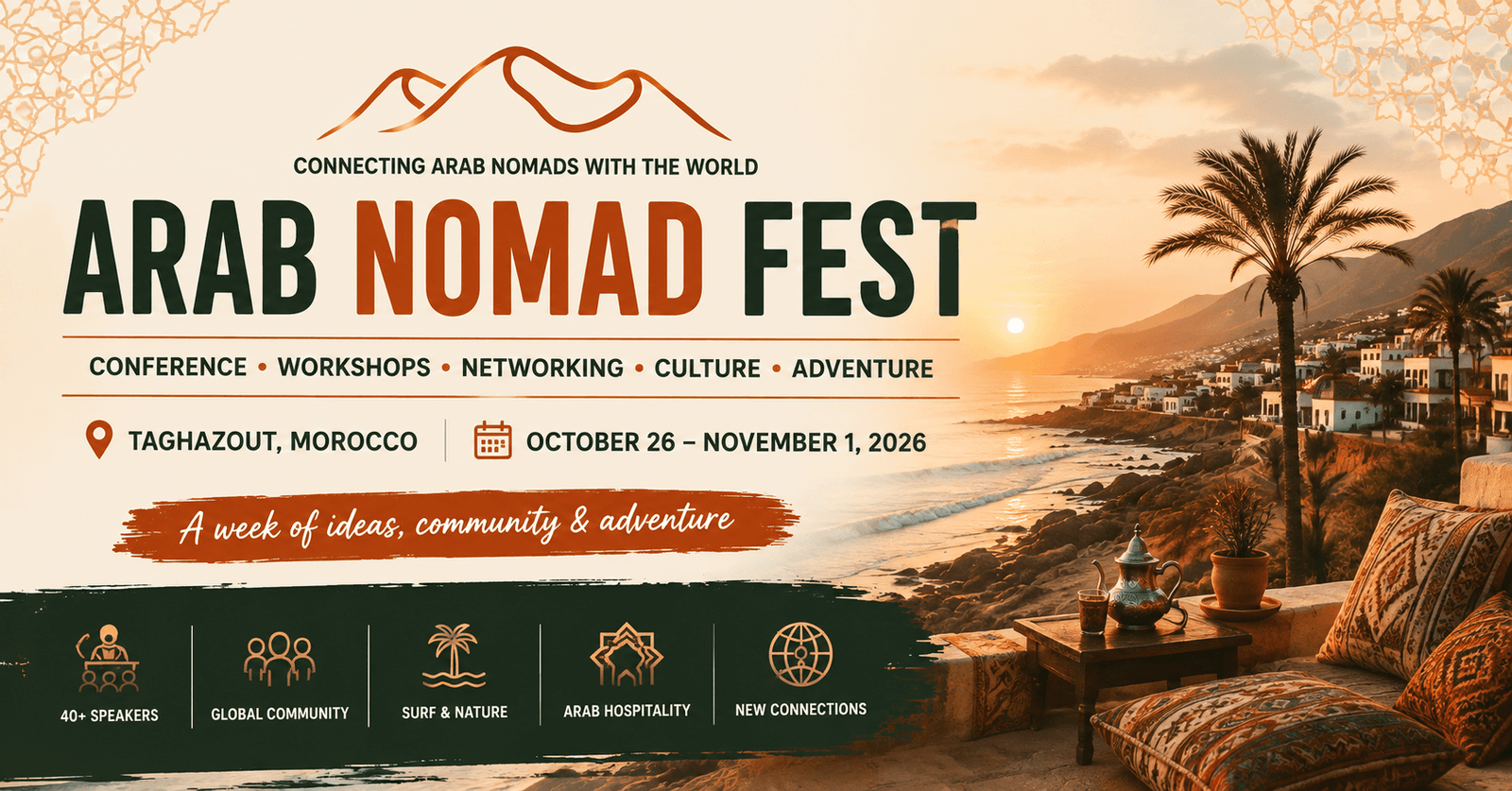
He is the founder of Arab Digital Nomads, a community, destination atlas, and visa database for Arabic-speaking remote workers. And the organizer of Arab Nomad Fest. Seven-day festival in Taghazout, Morocco, from October 26 to November 1, 2026, with sixteen speakers from sixteen countries.
 محمد شيخ الأرض
I met Muhammed at a workshop in Kuala Lumpur. What stuck with me was how little of his story is about asking for help. He studied gastronomy at Le Cordon Bleu in Istanbul on a half scholarship. Slept in student rooms when the money ran out. Sold Cappadocia tours to Erasmus students for commission. Learned video editing from YouTube, and landed his first dollars on Upwork. Along the way he met his wife, a Ukrainian who had also fled a war to Istanbul, and they now raise a trilingual daughter in Hoi An, Vietnam. Where he taught English to classes of fifty while freelancing on the side.
Muhammed and Arab Digital Nomads
- Arab Digital Nomads — the community, destination atlas, and visa database Muhammed is building for Arabic-speaking nomads
- Arab Nomad Fest 2026 — the first edition in Taghazout, Morocco, October 26 to November 1
- Arab Nomad Fest tickets — the ticket page with the full program
- Arab Digital Nomad on Instagram — where Muhammed is most active
- Muhammed Alard on LinkedIn — his professional profile
- Alard Production on Behance — his video editing and videography portfolio

Syria, the Levant, and the Gulf
- Damascus — Muhammed's hometown and one of the oldest continuously inhabited cities in the world
- Umayyad Mosque — the Temple of Jupiter that became a church and then the Great Mosque of Damascus
- Levant — Syria, Lebanon, Jordan, and Palestine, the region Muhammed contrasts with the Gulf
- Gulf states — Saudi Arabia, the UAE, Bahrain, and Qatar, where he grew up
- Amazigh — the indigenous people of North Africa he mentions when describing Morocco, Algeria, and Tunisia
- Bedouins — the original Arab nomads and the root of the word Arab
- Syrian civil war — the conflict that closed the borders in 2014
- Arab Spring — the wave of protests that preceded it
- Syrian refugees in Turkey — the context for the citizenship program Muhammed went through
- Islamophobia — the reality Muhammed says still shapes how Arab passports are treated
Ibn Battuta and the nomad tradition
- Ibn Battuta — the Moroccan scholar who traveled for nearly thirty years across Africa, the Middle East, India, and China
- The Rihla — the book of his journeys
- Marco Polo — the European traveler he is usually compared to
- Arabic coffee — the spiced coffee and hospitality ritual of the Bedouins
Turkey, Vietnam, and Southeast Asia
- Istanbul — where Muhammed studied, met his wife, and became a citizen
- Özyeğin University — his university in Istanbul, partnered with Le Cordon Bleu
- Le Cordon Bleu Istanbul — the culinary program he studied on a half scholarship
- Cappadocia — the destination of the tours he sold to Erasmus students
- Erasmus+ — the exchange program that brought his first international friends to Istanbul
- Hitchhiking — how he and his friends crossed Austria on five days and no money
- Hoi An — his current base in central Vietnam
- Da Nang — the neighboring city and home of Da Nang Nomad Fest
- Ho Chi Minh City — where he first taught English and decided the pollution was too much
- Ninja Teacher — the YouTube channel and TEFL program that put Vietnam on his radar
- Chiang Mai — where he met the nomad community for the first time
- Lombok — the family trip before he left for Morocco
- Taghazout — the Moroccan surf town hosting Arab Nomad Fest
Nomad events and community
- Da Nang Nomad Fest — the event that introduced Muhammed to the organizers and sparked Arab Nomad Fest
- Arab Nomad Fest on Freaking Nomads — the event listing with a 25 percent discount code
- The Modern Nomad Lifestyle in 2026 — on loneliness as the most documented cost of nomad life, and why in-person community is the answer
- Dorota and Krzysztof episode — my previous guest Krzysztof, whom I mention on passports and geopolitics
Money across borders
- USDT — the stablecoin Muhammed uses to send money to Syria and Vietnam
- Stablecoin — crypto pegged to the dollar, the bridge between his Turkish bank and cash in Damascus
- PayPal — blocked for Turkish passport holders
- Wise — the account I use for my UK company
- Revolut — my personal account since 2018
- Papara — the Turkish fintech I asked about
- Hyperinflation — why Istanbul became too expensive to stay
- Upwork — where his first online dollars came from
Healthy habits
- Pickleball — twice a week in Hoi An
- Bánh mì — the slow-morning breakfast
- Vietnamese coffee — the coconut coffee breakfast habit he mentions
Timestamps
00:00 Start
01:09 Syrian kid in the Gulf, road trips home
06:52 Damascus: temple, church, mosque
08:17 Nerd on Tour recommends Wise and Revolut
11:16 $4,000 stolen on his first solo trip
17:59 Stuck in Turkey, father arrested by Assad
21:22 Fake passport sticker, hitchhiking Austria
27:37 Nerd on Tour recommends SafetyWing
29:33 Becoming a Turkish citizen by lottery
32:39 Hoi An: teaching 50 kids, freelancing online
37:27 A Ukrainian wife, two wars, one family
44:11 English via Erasmus kids and Cappadocia tours
50:33 Le Cordon Bleu on half a scholarship
55:17 Google, Upwork, first online dollars
57:51 Chiang Mai, Bedouins, and Ibn Battuta
63:16 Arab Nomad Fest in Taghazout, Morocco
69:58 Why in-person beats online meetups
76:05 Passports, Islamophobia, closed borders
81:41 PayPal blocked: crypto to send money home
88:07 Pickleball, slow mornings, find him online

Quotes
People still value connecting to each other, learning from each other, and experiencing travel in a unique way, regardless of how technology improves.
This is a better investment than any course you would ever buy.
Crypto is amazing for transferring money from border to border.
You don't need to work full time to actually earn decently.
Transcript from the conversation with Muhammed Alard
Read the full transcript
Muhammed Alard (00:00)
I'm now in my living room and we are doing this podcast. But in reality, connecting in person, human to human, is way, way better, regardless of how technology improves. And also with the age of AI now, you can ask anything and you get the response so fast. But people still, you know, value connecting to each other, learning from each other and also experiencing like travel in a unique way. So
Piotrek Bodera (00:32)
All episodes of my Nerd on Tour Podcast are available for free. To listen to other inspiring nomad conversations, I encourage you to subscribe on YouTube, Spotify, Apple Podcasts or your preferred app. For full show notes, links and transcripts, go to nerdontour.net. It's my specialized blog designed for digital nomads. Besides podcasts, I write about slow travel, useful tools, and fostering great relationships. And now
Let's start the show.
Hello Muhammed
Muhammed Alard (01:08)
Hello, hello.
Piotrek Bodera (01:08)
I'm very happy to see you here in my podcast where we will be covering a lot of your story and what you are currently building. And honestly, I would never imagine that I would have a pleasure to talk to someone who grew up in a such an unknown place to me. So if you could start there. What are your memories?
of growing up in Syria.
Muhammed Alard (01:39)
All right. Well, first of all, thank you very much for hosting me and having me. It was a pleasure meeting you in Kuala Lumpur in Malaysia. That's really close place to my heart as well. So answering your your first question, how is it like growing up in Syria? Well, I didn't really grow up I would say in Syria. We we were doing me and my family trips to Syria every summer.
So I am from Syria originally, from Damascus. But my father was a businessman. My family were living in the Gulf. So my father grew up in UAE, United Arab Emirates. And in United Arab Emirates I spent most of my childhood and then we moved actually to Saudi Arabia and then I I continued my education in Saudi Arabia.
And every summer we were doing this long road trips with the family, from UAE crossing all the countries towards reaching Syria finally. It was very adventurous, like at a young age, we were young kids, me and my brother at that time, and my father, he had this you know adventurous spirit. He wanted to instead of going by plane, he wanted to go on a road trip and crossing multiple of countries.
And yeah, it was from a young age we were always spending interesting time in the road and with the family. There was a lot of challenges, the tires, you know, were going down or the car was stopping. Yeah, there there was a lot of like mini challenges I would say. But even though like it was a fun experience in general, and I still can recall it till now.
Piotrek Bodera (03:31)
Okay. So it does sound like you enjoyed your childhood despite different challenges that we'll be talking about them in a minute. But because you are characterizing yourself, you describing yourself as a as someone who is from Syria and and you feel connected to this culture, to this place. Could you tell me how Syria is different from
other Middle Eastern countries.
Muhammed Alard (04:02)
Yeah, well every Middle Eastern countries in general is quite diverse. It's like you can imagine it as if you go to Vietnam and you wanna compare it to Thailand, you have a lot of differences, right? You you can't say it's one country, you have different languages, different even like culture variety. same thing with let's say Syria and Saudi Arabia. We we speak the same language, so it's Arabic, but we have different dialects.
in terms of language and also we have different culture. So the way also we eat like foods is very different. So Syria is considered part of Levant, a region that includes Syria, Lebanon, Jordan, Palestine, and we there is a Gulf. Gulf is also different in their their lifestyle, their culture, they are more close.
to each other. So Gulf are like Saudi Arabia, UAE, Bahrain, Qatar They've been like more more like tribal, more Bedouin, more and then they discovered oil, they become richer. While Levant they we were conquered by many different empires. So we are more mixed also in terms of how we look and also these empires like
we inherited their food, their also some of the habits. And in terms of Syria, we have a lot also a lot of diversity in terms of yeah, like not only food but also religion as well. So it's it's quite interesting to see these differences in most of these Arabic countries. And if you go also to North Africa like Morocco and also like Algeria, Tunisia.
They have also different story. They are mixed with Amazighs They know Arabic. They speak maybe Amazigh as well. They are influenced by Amazigh tribes. So it's it's different. They have their own language. It's very interesting mix, I would say. They we we have a lot of diversity in MENA, Middle East and North Africa. So it's very interesting region to travel through.
Piotrek Bodera (06:23)
Yeah, I would love to experience it. In person, the only place from this region that I managed to see was Morocco, actually Taghazout where you'll be heading soon, but we'll be talking about it in a minute. I would be curious then that once the situation in Syria is stabilized and the infrastructure is rebuilt and they are make it safe to travelers.
would you say like Damascus would be this main point, main place that you would recommend for people to see?
Muhammed Alard (07:00)
Yeah, definitely. I mean I'm from Damascus. so I I will promote my my own city.
Piotrek Bodera (07:06)
Of course.
Muhammed Alard (07:07)
But but also Damascus, it's the oldest inhabited capital in the world. It's it's really old. So it's very interesting to see. We have also like ancient churches, like old history. There is a old temple that is we call it the temple of Jupiter. It's in the old town.
And it have a really long history and it was then transformed to a church, from a temple to a church, and then from a church to a mosque. Now it's the most important mosque in Damascus. It's just next to the gras Damascus Grand Bazaar, you can say. It's magical, it's very beautiful, the architecture, the it has a very different vibe, I would say. And some some religious people believe that Jesus Christ will
will be coming to that location specifically. So yeah, you can there's a lot of stories about that this place. So if you are interested in history, you can learn a lot. And yeah, it's it's an interesting place to visit for sure.
Piotrek Bodera (08:19)
I have been using Wise since 2016, back when it was still called Transfer Wise. Today it is the main business account of my British company, Nerd On Tour LTD The problem it solves. A regular bank charges 1 to 3% on every purchase abroad and hides more in the exchange rate. Spend $3,000 that way and you lose about $90 without noticing.
Wise shows me the real rate and the fee before I confirm. I hold Euros, pounds, dollars and local currencies in one place. The card sits in Apple Pay, and Wise ships a physical card to wherever I am. In Asia, I pay with local QR codes. Idle balances earn variable three and a half percent a year. The catch one day Wise will ask for proof of address.
Keep a recent co coworking statement ready and keep a backup account. Mine is Revolut. Try at nerdontour.net/wise slash wise. I pay for Wise myself. The link supports the podcast. Revolut has been my main personal account since twenty eighteen. I have used it across Europe, Asia, Australia and the USA.
The app works the same everywhere. The problem A card from home bank was never designed to work in multiple countries. The fraud detection freezes it at the worst moment, usually at an airport. The exchange rate is a mystery until the statement arrives, and the cash in the account earns nothing. With Revolut, I confirm payments with face ID and freeze or unfreeze the card myself.
On a paid plan, I exchange currencies without fees, the lowest rate I have found anywhere. Spare money sits in a cash fund at variable 3.5% a year. The plan includes a global eSIM data for the day I land somewhere new. Plus NordVPN, which I would pay for anyway. The catch, don't rely exclusively on Revolut while nomading. Keep a second account. Mine is Wise
Try personal account at nerdontour.net/revolut slash Revolut and business account at nerdontour.net/business slash business. I pay for my own plan. The link helps my podcast.
Would you like to regularly receive intriguing content like this? Then subscribe to Nomad Tuesday. Every week you will get an email from me with fresh podcast episodes, practical tools, and fascinating Nomad stories. Subscribe at nerdontour.net
You are mentioning the different religions that were in this specific spot and honestly I find it fascinating that it's so old and so ancient that those transitions, yeah, as you are saying, that one temple could serve the ancient gods from the time when it was part of the Roman Empire, yeah, and then the Christianity was dominant and then Islam became dominant and they made it into
their own mosque.
Muhammed Alard (11:48)
Mm-hmm.
Piotrek Bodera (11:49)
It's very interesting that me being right now in Kuala Lumpur in Malaysia, there are also some minorities of Christians here. And I try to like track back, you know, how it happened that kind of Christianity or Islam came here. And then I realized that you know some of the people like the Indian Malaysians that are here would be actually connected to Christianity
before the Roman Catholic Church, yeah, the one that is the most kind of dominant today. So basically it's older than my own country, Poland. Yeah. So and and older than the idea of like Poland being a a Christian country.
Muhammed Alard (12:31)
Yeah, it's it's very fascinating actually. Like you can learn a lot from from these stories and different countries that you're visiting and how politics, religion and like people moving from a place to a place impacted the place or the country you are visiting.
Piotrek Bodera (12:50)
Mm. And coming back to what you said about those road trips with your family.
Muhammed Alard (12:57)
Mm-hmm.
Piotrek Bodera (12:58)
It's also something that it's hard for me to imagine because I still remember when Poland was not part of the European Union and our summer vacation, like to go to Italy, took a lot of time because going by car and crossing the borders with Czechia, with Austria and then Italy, it's always took so much time and then you know, passports and whatever, custom controls. Yeah.
How it was back then? Yeah, like how could you tell, you know, the story of you living in three different countries and then crossing them by car? Also, like what was the infrastructure? Do you have highways between them or is it like you go through a desert? Yeah, yeah.
Muhammed Alard (13:42)
There is a highway in the middle of the desert and sometimes yeah, we were having flat tires because some areas in the roads like were not, you know, suitable. But in general it was yeah, it was okay. Like yeah, they we had to stop for many hours in each border. They were checking our bags and everything, and and yeah, they there is the typical border stops. But in general it was it was okay. We had
We were living in the Gulf at that time and we are Syrian originally, so we were passing Jordan and at that time there was no visa problem to cross to Jordan on and also like in general crossing towards Syria. So it was it was totally fine until of course the war happened that changed how how the world look at Syrians and how
they are treated. so yeah, this is a different story.
Piotrek Bodera (14:46)
Yeah. Okay, so let's stay for now in the spirit of traveling and I would like to know what was your first solo trip?
Muhammed Alard (14:58)
It was a long time ago, actually, when I was I just graduated from or I not graduate yeah, I graduated from high school. So I finished high school and I was l looking into going for a university and I was looking at the options. And the first stop was Jordan. So the idea was to look for a suitable university in Jordan. So I took the first solo trip.
But it was a very terrible experience. I was really young and and yeah, didn't know really how to manage traveling alone, so I got my money that I had to suppose to pay for a university stolen. around four thousand dollars or something. Yeah,
Piotrek Bodera (15:46)
Gas.
Muhammed Alard (15:48)
so I found myself without money in in in Jordan in a new country. And yeah, it was
a a terrible experience and then I ended up I I said I don't want to stay in Jordan anymore. I got my money is gone. it just like gave me a negative experience. So I said, okay, I'll go back. it was Saudi Arabia at that time and then I had dip I w I was depressed and 'cause I I wanted to just, you know, be s in somewhere new. But yeah, I I came back to Saudi and then I started to study there actually.
But then it was too too expensive to continue my education. So I had to stop again. And then I applied to go to Turkey, to study at that time. And then I got a scholarship in Turkey and and I ended up going to Turkey.
Piotrek Bodera (16:41)
Okay. Yeah, I'm glad that some time has passed since your negative experience in Jordan, but honestly, every experienced traveler or nomad has it.
Muhammed Alard (16:53)
Yeah, that's true.
Piotrek Bodera (16:55)
I feel like we need to have this bad experience to grow, you know, to to thicken our skin and then face any other challenge that will come our way and we will be like, Okay, if I manage to go through this, I will definitely be able to go through anything.
Muhammed Alard (17:17)
Yeah, that's for sure.
Piotrek Bodera (17:19)
Interesting that that your first stop or your first idea was was to study in Jordan, but you end up in Turkey. And yeah, how how it is, because again, I feel like so many people in the Western world, myself included, are very privileged in how many of the paperwork in bureaucracy is actually very easy for us. Yeah, like me being a European
I can go to any European country, like, you know, on the spot and decide to leave there. Yeah. And and it it's it's like nothing is stopping me, in theory.
Muhammed Alard (17:58)
Yeah.
Piotrek Bodera (17:59)
But why Turkey and how it happened that you end up there?
Muhammed Alard (18:05)
Yeah, it it was it was basically because of convenience. So Turkey didn't had a visa application for Syrian at that time when I came. So it was just an easy choice. I just entered Turkey at that time. It was around two thousand fourteen. And yeah, I entered without visa. I got a scholarship and I started study, but wha then the it was already the Arab Spring and the Syrian war was starting like
conflicts. So then they closed the border. So they closed the border in Turkey. And then we get I got stuck basically because I I could leave but I can't come back easily. And also my parents couldn't visit us because of that. Because they closed the border and it was more challenging now to get a visa for them to visit. Especially like we didn't know how things work.
It was very new. And then like the situation a bit escalated in Syria and then it became it became a real like like very hard to see what was happening. so it was impacting like my psychological well being as I was a student at the time. But yeah, I couldn't do anything basically so
So at that time my family returned actually to Syria and they wanted to sell the house because they were like financially struggling. So yeah, it was it was not a good time. So one day my father was trying to sell the house, he got arrested by the regime, the previous regime that we had, and and he he they basically saw that he have shared a post on Facebook.
that he's against the regime and he was imprisoned for pol political reason and just disappeared. Like we didn't know anything about him for for many months and it was a very difficult situation. So yeah, especially like we can't I couldn't do much about it at that time. It was a very difficult time to try to make sense of what everything was happening and also hearing the people that were
being killed, kidnapped, or being imprisoned for for just being against the dictatorship that was happening at that time in Syria by Assad regime. So so it was also challenging here in Turkey. I was on a student visa. So I had like a permit, but but the thing is it I had to renew my my student visa and
I remember at that time I needed to leave, but there was no place to leave. Because of the war and because of of everything happening, almost all countries have closed its border to Syrian citizens. If you have a Syrian passport, you can go anywhere because a lot of Syrians were like crossing to Europe. They were trying to kind of make a life for themselves, escaping from the dictatorship that was happening and and so all countries close its borders.
So I wanted to renew my visa and I find myself I'm I'm not able to even renew my passports because the embassy at that time was like closed down in Turkey. And even if you wanna renew your passport, you had to pay so much money just just to do so. So it's it was a terrible situation and I didn't know what to do and I ended up I remember to like pay someone, like to fake
to ha like use my passport but like create a fake sticker. We were using sticker to renew our passport. And I paid someone to make a fake sticker to change the dates. And somehow it worked.
Piotrek Bodera (22:06)
Okay.
Muhammed Alard (22:07)
and because of that I was able to to leave and and just to renew my permit, my student permit. But for some somehow it it worked for me, like I managed to to apply for a scholarship in a program in Austria and I was I managed through the student permit I had to visit Austria for the first time during my student time. So
I remember going to the embassy saying, I'm going, I'm a student, I'm going to Austria for this program. And then the the staff from the embassy told me, but you know, there's a lot of Syrians are going, what's the reason we should give you the visa? How maybe you will just stay there and we don't want that. So I I just promised that I will return. And they somehow give me the visa because I I
I got an invitation from also a friend, Austr Austrian friend as well, who I met in Istanbul. She was a Erasmus student. And then I ended up going to Austria actually and traveling Austria. And after that, yeah, it's it was very difficult to get the Schengen visa. But I got it because I'm a student. So it worked because of that. But if if it will if I was not student, I wouldn't be able to get it, I think.
Piotrek Bodera (23:31)
Unbelievable. Honestly, I I I feel shivers when I hear this story because yeah, first of all I'm I'm very sorry to what happened to your dad and that you you needed to go through all of this and have like no knowledge, yeah, no no information of like why where is he kept and and how long you know is the the the sentence, yeah. Like it of course any time there is like
political reasons they they don't make it fair or there is no justice, there is no judge yet. There is you know locking people
Muhammed Alard (24:11)
Just corruption. Yeah.
Piotrek Bodera (24:13)
Yeah,
and and then the other thing is what you're saying is honestly I thought it's history, yeah, in terms of when I read what happened around Second World War, when people were like running away from Europe and it's it's very similar pattern that's that that you're saying, yeah, that they had a paper and then sometimes they needed to forge the date, yeah, or forge some stamp or something, because that was the only way to escape.
And then luckily on the other side of the Atlantic, yeah, or or in Australia or somewhere, they were like, okay, yeah, they were they were nodding that we kind of understand the situation and we look at the paper, and the paper is like it's fine. So that was the only way, yeah, for for them to to go anywhere. And wow, yeah, like I I I'm really impressed about your perseverance and and the ability to kind of
you know, wiggle around and to to find the solution. Yeah. And I'm wondering now because you started in Turkey, you you were officially student there, and so you had the student visa there. Then you went out to Austria, which kind of like helped you to renew the papers. Do I understand it correctly? And then you came back to Turkey?
Muhammed Alard (25:35)
Yeah, I renewed the papers actually through going to Cyprus. I went to Cyprus first and then I I just wanted to I I wanted to travel really. I I was meeting a lot of international students at that time. And I've heard that my university have this summer program in Austria and that's I how I applied. And so I was like, Okay, let's try. You know, I will not lose anything and and actually I ended up going for five days.
Piotrek Bodera (26:05)
Okay. Excellent.
Muhammed Alard (26:06)
So
yeah, how that's how it was. Yeah, I met some friends from Austria. We became really close friends. We were like cooking together here in Istanbul. Mm-hmm. And yeah, we were like really good friends and and then they made an invitation for me and I said I'm going also to join this program. But then the funny thing is like the visa like the people from the embassy in Austria, they gave me the visa but they gave it to me late. So I missed the program. But I ended up going anyway.
Okay. To Austria visiting the friends That's that's how it was.
Piotrek Bodera (26:42)
That's that's good that you're not pushed away because of the bureaucracy and the slowness.
Muhammed Alard (26:48)
Yeah, and it it was a really like fun five days. So I had five days. But it was really fun because I got introduced to hitchhiking, you know, we were hitchhiking together, low budget traveling. We were all students, so we were like extremely low budget. And my friend she introduced to her classmates, so they hosted us in their home and we traveled to different parts of Austria.
pitch hitchhiking like stopping cars in the middle of the road and with a backpack and and then we couch surfed as well, like in a random people's house. So yeah, it was fun experience. Like a really good memories and yeah eating eating like Austrian food also. Like yeah, a lot of fun.
Piotrek Bodera (27:37)
Excellent. Yeah, yeah, yeah. I I I totally get it. And I have similar background in backpacking and peach hiking and couch surfing. All of those are very fond memories. So I'm happy that you you had the chance to do it as well, despite the circumstances and the issues with the passport. I have had SafetyWing Wing since twenty twenty. It is the only insurance I've kept the whole time.
while on the road. Most travel insurance has one line in the fine print The trip ends after 30, 60, or 90 days away from your home country. Nomads do not have a trip. Traveling is our way of life. Many policies also require you to buy before you leave home. If you are already in Chiang Mai, you're out of luck. SafetyWing Wing Nomad Insurance runs as a subscription.
Start it from anywhere, even mid trip. Keep it for a week or four years. The essential plan covers medical treatment up to two hundred fifty thousand US dollars, but also evacuation, lost luggage, motor accidents and leisure sports Every time I have written to them, they answered quickly and actually helped. The catch it is a travel medical insurance.
Not a full health plan. For that, consider upgrading to the higher plans. Go to nerdontour.net/safetywing slash safety wing and use the code NERDONTOUR for eight weeks of free electronic theft coverage on a new Nomad Essential plan. I pay for my own plan. The link supports the show.
But I I really love your story that each time we talk through there is like a next step that shows that you achieved even more. So you actually became a Turkish citizen. Can you tell me how?
Muhammed Alard (29:49)
Well, there is no how actually it's yeah, there is there's different paths to become a Turkish citizen. well the most traditional path is through investment. So if you you are buying a property, you can basically like get elected to become a Turkish citizen. Or of course if you marry a Turkish citizen, then after three years you can apply. Which is like in most countries is like
Same pattern, but for my situation it was very different. And I was lucky in that way. because there is this period where there was a lot of Syrians coming to Turkey, and I was one of them, you know, coming without a visa, and then we kind of settled here for a while because we couldn't go back. and then the Turkish government they decided to give them some kind of support.
So they give some Syrians who kind of gave back to Turkey like a special what do you call it? Special treatment We got what is called citizenship but by specific case, let's say. And so it's not the traditional route. so anyone who had established a business, let's say, or studied in a university in Turkey and then started working and
kind of giving back to the economy. They were picked and then went through a process. It was a long process, to be honest, of different stages. And then yeah, but it was pretty much random. It they it wasn't for everybody. They picked like a number of like hundred thousand people or something. And then these hundred thousand went to several steps. Like it was around six stages. So there was a message, you receive a message, you go to
immigration, then you do like a small interview, you s you bring your papers. If a paper is missing, you miss the s your chance. So it was very it's very like specific. And then you you had to wait and follow up, you know, with what's going on. And and I remember like my brother got that message and I didn't get it. For like two years after him, he got the citizenship and I didn't get it, even though we came at the same time.
so it was a bit random also. But then I I applied for a petition about my situation that my brother got it and then I sent it to to Ankara to the capital and and then I got a message and then I went and went through the process and got it. So yeah, it was it was it was not easy. But yeah, I got I ended up getting it finally.
Piotrek Bodera (32:39)
Excellent. Yeah. And your story doesn't end here because you actually I felt okay, the freedom is finally here because you have a passport that is recognized and you can start traveling. So right now your base is in Hoi An, yeah, in Vietnam. So why is it? Why did you pick this place?
Muhammed Alard (33:02)
Yeah, Vietnam is a very beautiful place, very beautiful country with beautiful people. We didn't really know about it before. We were traveling, I remember like when I got the citizenship and I I met my wife, she's from Ukraine. We met in Istanbul and then we had a daughter. So my daughter was born in Turkey. So after I got the citizenship, I was like able to move more easily. I said like let's go to Thailand.
So we went to Thailand and started traveling, we went to Malaysia, we went started, you know, going around Southeast Asia and then then I heard about Vietnam through a actually a YouTube video. There's a guy a YouTube channel called like Ninja Teacher. He's he have an agency to help people to get certified and start teaching English in Vietnam. And he was telling about that and it was very interesting.
also how much they pay for for foreign teachers. I was like I thought to my wife, like I joked, like how about we go and teach in Vietnam like and also maybe work online too, like combine both. Because you don't need to work full time to actually earn decently. And that's what yeah, I I I tried to apply for the visa. When we were in Thailand we tried to apply but but it was a bit more challenging for our citizenships. But then
On in 2024 they introduced that electronic e visa for for all nationalities. so I applied and I was like the f one of the first one maybe who applied and I got it. And then I said, Okay, let's go. I w we were in Istanbul at that time. We were back in Istanbul. So I said, Let's go and yeah, we ended up going and because Turkey at at that time was and still till now was having
hyperinflation. So it was a bit difficult to manage our expenses. Prices were like raising like crazy. Still it's still the situation by the way. Turkey is its economy is like pretty much tough, I would say. So yeah we ended up going to Vietnam. My wife started teaching in a kindergarten and I I wanted to also experience it.
And yeah, I I got the chance to even though I'm I'm not from UK or US or Australia, but I got an offer in a public school and I started teaching English for like fifty students in a class. So it was like whoa, like it was like a first experience teaching and directly they put me in a fifty student class.
Yeah, it was an amazing experience. Very like very different, I would say uncomfortable environment for me, but it was a good chance to practice some public speaking.
Piotrek Bodera (36:11)
That's cool.
Muhammed Alard (36:13)
So I'd started teaching for for a while and while I was working online, so I I'm a freelancer originally. So I I was doing that since we were in Istanbul. So I was like, okay, I have this hours during the morning days where I teach, and it's not full time, so it's part time. So the rest of the time I'm I'm doing my what I do usually. So it was very good. We were making good money and and yeah.
I ended up like teaching in in Ho Chi Minh first, but I didn't like Ho Chi Minh. It's very crowded, it's very polluted. And then and then I said to my wife, okay, we can't stay stay there. From the beginning I wanted to go to Da Nang and then I said, Okay, let's quit and let's go to Da Nang and I fell in love with Hoi An especially not Da Nang itself. Especially for my daughter, it was much
better decision and we are my wife now thanked me that we took that decision and we went because she was really hesitant to move. But yeah we we did it and we moved and we live now already for a year in Hoi An
Piotrek Bodera (37:27)
That's so nice. And I'm glad that you mentioned already that you have a wife and a daughter, because I feel like this is yet another step for all the aspiring digital nomads for everyone who is already doing that for many years and maybe b they are struggling in like finding a partner and you know, having a proper relationship. But it seems that you already cracked yet another challenge, combining being nomadic.
and having a proper family. So you mentioned you met in Istanbul.
Muhammed Alard (38:03)
Yeah, both of us ended up in Istanbul because of war actually. Yeah. So I ended up because of war in Syria and she ended up also in twenty fourteen. the same time I came here. She's originally from the east of Ukraine. Okay. And at that time, you know, Russia was kind of taking part of Crimea and also other east of Ukraine area.
So their house ki got bombed by by Russia. gosh. Like so yeah, they she left first, but then her family also followed, so all of them basically moved to Istanbul. So we met in Istanbul because of that.
Piotrek Bodera (38:47)
Again, it's unimaginable for me to to live through all of this, but do you honestly feel like this hard experience created like a very strong bond between the two of you?
Muhammed Alard (39:04)
Yeah, for sure. A hundred percent. It's irony or kind of a bit weird, to say like okay, both of us have a war-torn country but we ended up, you know, being together. But yeah, that's I think that's how c we connected deeper because of that, but because also we understand both of us understand like struggles and also hardships of that
situation and we both hate war and hate what it brings, how it can change people's lives. But also we both experienced, you know, being in a foreign country speaking different language. Like in Turkey it's here is v they are very nationalistic about their language. They they don't expect so if you are here in Turkey they directly expect you to speak Turkish from your from day one.
They especially if you if you look like like yourself or like me, they s expect directly like you are Turkish because they are very mixed. So they already start to speak Turkish with you and and if you they put you on the spot, you know, and you were like I don't know, like you start speaking English, then not everyone speaks English. So it's a bit challenging also in that way. So we had to adapt, we had to learn the language and also we had to
find ways to work things out and luckily also she liked to travel. Like she's a traveler herself. She traveled more than me. She's she's an epic traveler. She was working random jobs long time ago and saved money and travel around the world like for many countries. So yeah, that's also connected us. I like to travel and that also bring us more together. Mm-hmm.
Piotrek Bodera (40:56)
I'm so happy to to hear that. Like it's a similar case for my partner. Like we we love traveling and this created this very strong bond between us as well. And again, like it's something that many of my fellow nomad friends, they usually keep their relationships or you know, their romantic interests within the same bubble, yeah, within the same culture, the same language.
maybe sometimes, you know, a European from another country and it's already, you know, a French and German, like, my God, so many differences. So I wonder how it is in your case, especially in terms of like the religious background, do you experience any any issues on that line?
Muhammed Alard (41:44)
Yeah, there's a lot of issues. But but yeah, you I had to compromise, you know? We both had to compromise and be more like understanding to each other differences. I think it happened slowly. So I focused on the shared values rather than the differences. And there are a lot of differences by the way. So you know, in Islam we don't drink alcohol, they drink alcohol a lot, especially
Like her her father, he's an alcoholic. It's a big clash. And also like eating, I don't eat pork. So they the family eat pork. So we had I had to kind of be understanding of those differences and changes and and honestly I'm not that religious but but still I still try to follow more or less and maybe that also helps in that term. Maybe if someone
Other than myself, maybe if if they are too religious or too strict that wouldn't work. So yeah, it it it's still it's still taking like there's still some issues here and there, but in general like all now we kind of it's been seven years, so now we know how to kind of work it out.
Piotrek Bodera (43:05)
Yeah. I'm so happy to to hear that you're both focusing on the common values, yeah, and the common space that that really unites the two of you and allows you to to travel and to experience the world.
Muhammed Alard (43:22)
Yeah, exactly. And languages also, like we speak different languages. So like with my daughter, we agreed from the beginning that she have to it's better for her to speak different languages. It's very important for her mind. So like we agreed, okay, I'm gonna speak with her in Arabic so she can learn. And her mother will speak in she they speak Russian in east of Ukraine. So she speaks with her Russian. And English is the common language. So actually my daughter
learned English just from hearing us communicating with each other. And
Piotrek Bodera (43:55)
Okay.
Muhammed Alard (43:55)
yeah, she she learned English like from just passive learning. No school, nothing. Like
Piotrek Bodera (44:02)
She's not one of the fifty kids that are attending your classes in Vietnam.
Muhammed Alard (44:08)
No, not really.
Piotrek Bodera (44:11)
But honestly, then how do you balance all of this? Because I hear there are so many projects or you know, life things that you need to juggle because you are kind of based in Vietnam. Currently you're in Turkey, you're on the way to Morocco for the festival.
But then your daughter and and your wife, they have their needs as a family, as as your partner. How are you able to like, you know, manage it all?
Muhammed Alard (44:42)
It's not easy. There's a lot of challenges, of course. So we we just like communication together. We say, Okay, like I have this going on, I'm building this. So it's a period and then I kind of tell them, Okay, I'm going for that period, but before that we can do something together. So before I leave, we went together to Lombok in Indonesia. We had a really nice family adventure.
Together and also before I leave from Vietnam we were like going into dates regularly and hanging out with with my daughter in the beach. So yeah, so it's like that. But yeah, I'm gonna be away now for a while. for a long time actually. But it's it's the idea is I'm I'm building something. So hopefully that will bring something good for the family later on. So that's the idea. So we agreed on that.
Piotrek Bodera (45:42)
Nice. It is important. The communication I would say it's foundational for any relationship and especially once the kids are there and they also have their say or their their needs. So you mentioned it that you work as a freelancer and you also work as a English teacher in Vietnam. But s I wonder starting with your Arabic language, yeah, which is your mother tongue.
And how come you're so good at English?
Muhammed Alard (46:13)
Am I? I don't know.
Piotrek Bodera (46:16)
I feel you are and and that's why I I feel that it is a skill. It's it's such an important skill for any digital nomad. So when and how did you learn it?
Muhammed Alard (46:27)
Well it it happens in different periods I would say, but I wanna thank my family. So they they invested in a private teacher. She was from Pakistan. she was teaching me like early on English since third grade when we were living in the UAE. So she was coming often and teaching me the basics, but but speaking happened during university. So I was meeting a lot of international students, my English was like
too much broken and then I started speaking more and practicing like more applying the language on a daily basis. So that's definitely improved the language because in Saudi Arabia and Arab countries you don't you really use the language much. So yeah, it was in Istanbul. Istanbul is like a hub meeting hub for many European countries. Erasmus coming and exchange students coming here. So I was meeting Europeans from different
you know, countries speaking different like accents as well. I was using the language while also meeting people, so it was a good way to learn even and practice more.
Piotrek Bodera (47:40)
Excellent. Yeah. So basically traveling and meeting travelers help you to polish it. Yeah,
Muhammed Alard (47:47)
For sure.
Piotrek Bodera (47:48)
for sure. I would say the same, that it helped me tremendously once I am you know somewhere else that I'm forced to use it and then you find ways to be more fluent and to, you know, joke in this language. So it really helps to even, you know, be fine when
You're making mistakes and it's like, damn it, I forgot to like say this or that. And it's like as long that as the other person understands it's
Muhammed Alard (48:15)
Okay.
That's true. That's true. Yeah, it's like the same thing. Like they try also to correct you or help you sometimes. So then you learn. And also what helped me also, I is running tours. So I was running tours in Turkey as well. So as a student, was doing I was collaborating with the agencies and then we were running tours for international students. And that helped also like building more like
A deeper connection with people and making sure they are having good time and yeah, it's all these small like experiences definitely like shape the way you are learning the language, meeting different people from different countries. Help you practice. So there was like a tour tour agency. They were organizing tours in Turkey to go to Cappadocia from Istanbul. Okay. So they wanted
I was like helping by selling tickets to an Erasmus students in the university and I was getting a commission for that so it was like a side hustle.
Piotrek Bodera (49:22)
So you you didn't meet up with them just to talk English, you you were actually selling this stuff.
Muhammed Alard (49:31)
Yeah, I I had to survive. Yeah, I had to survive either way, so
Piotrek Bodera (49:36)
No, no, again, like I I'm joking, but I'm really impressed by your ingenuity. And this is actually the segment that I want to go forward with your work. Because again, so many of your fellow Syrians escaped from the country and they needed to, you know, become the refugees. Yeah. Like that someone like, please help me because I lost everything. And in in your case, I hear that.
You were just very, very consistent and finding ways to stay somewhere, yeah, to get like proper visas or the citizenship and then to work. So of course having the English skills and then polishing them by selling tours to international students really help. and then I wonder how your studies in Turkey helped you to become a freelancer. Is that the case?
Muhammed Alard (50:33)
no, my studies really didn't help at all. I was a gastronomy student. I don't know if you know what gastronomy is. Cooking,
Piotrek Bodera (50:41)
Yeah, yeah, cooking and everything.
Muhammed Alard (50:43)
yeah. So I was into cooking. I wanted to learn this. I was in love with food. And yeah, I was an interesting major in general to study because I'm I I'm not a really good student. I I was a terrible student since a young age. I'm not a good student. So
Piotrek Bodera (51:00)
How did you get the scholarship then?
Muhammed Alard (51:03)
I don't know.
Piotrek Bodera (51:08)
Did you like cook something special and then serve it to your like you know head of the school?
Muhammed Alard (51:16)
No,
it's funny because like I got a scholarship actually on different major. I was supposed to study architecture, but then like because I didn't really like at this age, like you really don't know what you wanna do. And and yeah, I I ended up just saying, Okay, I like the idea of cooking. I was following MasterChef Australia, like it's a TV show. And yeah, I just said okay, let's let's just study that. Seems like cool.
And the my university is Özyeğin University in Istanbul. It's they they collaborated with the Le Cordon Bleu Like it's a a very like established, well known French culinary school. Okay. So I was like, sounds fancy. Let's do it. I have the scholarship, so maybe I can, you know, change the scholarship from architecture to study culinary. And and that what happened. Like I applied and they made an interview, like there was a
Four or five people from the faculty and they interviewed me. like because they didn't accept everybody actually. They they want to make sure that I actually enjoy food. And I I I passed the interview because I really liked food and I gave a few examples. So I passed the interview and I started to study. But it was it was, as I said, challenging because I'm not a good student.
I mean I I like cooking so practical practical lessons were really good. I was really good at them, but when it come to like food science or studying restaurant management, like especially math. I'm terrible at math and there's a lot of math lessons I'm I'm like I was failing sometimes, you know, some subjects. So so I ended up like and I I was still paying for this university. It was not cheap, you know.
So I didn't get like full scholarship. I get like around fifty percent. So it's half. So I still need to pay the other half. Mm-hmm. And it was not cheap. So at that time we were like struggling financially. So I said to the university, can you support? And no, they they didn't want to support. They were very like capitalists. And I find myself like in a really terrible situation. I had to sleep in student rooms because I didn't have money to
to you know like live in a proper dormitory or anything. And they didn't support at all. Like they didn't care. They really didn't care. And and from that time I had until now, like I I hate paid university education. I really like don't like them. They they are pure business. They don't care about you. They don't care about your well being at all. Like they don't they don't care really. So
So from that time, like I said, okay, I supposed to study like a bachelor degree. And I I said, I'm gonna withdraw and I'm gonna at least have it converted to to an associate degree. So I I did that. So I passed all the subjects until I got an associate degree from them just to get something out of my time there because it was a waste of money, honestly. Yeah. I ended up getting it, but I I really didn't use it.
Because I ended up doing something else.
Piotrek Bodera (54:49)
Yes. I feel like the part of life that you kind of need to figure it out yourself. And it doesn't really matter if you studied one thing and then you went to completely opposite. Yeah. Because the life will reward you for being flexible and for like having an open mind. And then yeah, stumbling upon the whole concept of digital nomads and your platform that we'll be talking about in a moment. But before we get there.
how did you then become the freelancer?
Muhammed Alard (55:20)
Yeah,
it was during my university time I was in a really terrible situation. So I was financially struggling and yeah, I needed to basically make some money. So I I went like everyone else, going to Google and saying like how to make money online. I had a laptop and then yeah, I started to learn and I was following some people saying like you can make money with some skill. So I learned video editing.
Mm-hmm. So I was learning with YouTube videos how to edit a video. And then I discovered the platform called Upwork. And I applied through Upwork and I got my first paying dollars through Upwork.
Piotrek Bodera (56:05)
And then I feel like you mentioned somewhere that you you moved from being a freelancer to a actual full time job. So was it the full time editing?
Muhammed Alard (56:15)
I never actually did a full time thing at all.
Piotrek Bodera (56:19)
Okay.
Muhammed Alard (56:20)
Never. Since all these years. I I didn't I couldn't actually do a full time like I tried to I did for some times what's called like we I get an internship, paid internship during the university period in a Four Seasons hotel. It's I don't know if you know it's like a five star hotel here in Istanbul. Yeah.
Piotrek Bodera (56:41)
Yeah yeah yeah.
Muhammed Alard (56:42)
It was part of my education at that time.
in the university as a as a cook. And yeah, it's I I just discovered that this is not for me. Like I stayed for the whole period. It was like three months. It was very hard, but yeah, I I discovered that there's a lot of things that the the university tell you it's cool, but in reality it's not cool.
Piotrek Bodera (57:05)
Of course they need to sell you the package of studies so they paint you the picture that you will be, you know, wealthy and you will find a job right away.
Muhammed Alard (57:15)
Reality
is not that I was hearing like chefs there saying complaining about their salary, how much they're earning, it's not enough for their life, blah blah blah. Working like until their body is completely destroyed, you you are standing like all the time, barely having five minutes break, usually go for smoking cigarettes like really not healthy lifestyle at all. Some people manage to do it and yeah, I respect that, but
It for me it was too much like I couldn't handle that that pressure. Very stressful, yeah, it's very stressful experience.
Piotrek Bodera (57:51)
So then you work a bit as a video editor through Upwork and at what point did you discover the digital nomad community and decided to create the Arab digital nomads?
Muhammed Alard (58:07)
So yeah, it was during my travel in Thailand. I went to Chiang Mai. We fell in love with Chiang Mai's It’s magical And we said then I met nomad community for the first time there. I think it was twenty twenty two or twenty twenty three, and then I met the nomad community and discovered the term digital nomad. I didn't know about it before. And I said, wow, okay. It would be cool to have a digital nomad.
For Arabs, you know, we don't have this term really known or we don't have like resources for people who are, you know, trying to work online. So why not establishing something like that? That's how the idea started basically.
Piotrek Bodera (58:52)
And it's interesting because the word Arab, as far as I manage to check, is actually coming from the Bedouins that you mentioned, yeah. So like the West from Levant, the territories of the northern Africa where we still have those analogue nomads, yeah, the people who are just coming from one place to another with their camels and that's how they have been living for thousands of years.
Do you feel like this concept, this part of culture is really alive across the Arabic world?
Muhammed Alard (59:29)
Yeah, yeah, it's I mean it's still there, it's Bedouins. You can see them in many different places in Middle East and North Africa, especially in the Sahara. They they still like preserve their their way of living, some of them. It's pretty much modernized now, of course, but but still they try to preserve it. Like generosity, they have like a lot of good values, generosity and they have this competition of speaking
fluent Arabic and poetry and also serving coffee in certain ways. Okay. Like they have very special coffee, Arabic coffee, very different than other coffee with mixed with some spices. And yeah, generosity with food. So yeah, it's it's still you can still see it. Now they do tours around also if you go to Oman or if you go to some other countries in the Middle East or North Africa you can experience some part of it.
Piotrek Bodera (1:00:28)
One of the best examples of this nomadic life is actually someone who you told me is like a better version of Marco Polo. So could you tell me more about Ibn Battuta and how he is an inspiration for nomads today?
Muhammed Alard (1:00:48)
Yeah, Ibn Battuta he's an epic traveler. You can watch some documentaries about him. He'd been traveling like starting from Morocco, actually he's Moroccan, and crossing all the way through Middle Eastern countries. Then he ended up in India and China, traveling for more than 30 years before airplanes and technology, and spending really long time on the road sacrificing
his time with his family, he left his parents and on the road he ended up being with many different partners as well, which is interesting at that time. And also meeting different emperors and experiencing like establishing and collapsing of of empires as well. And he documented all this journey in a huge book that you can now read. And so it's
Many historians say is that it have a lot of details about that time and era. So yeah, it's it's very interesting guy. He traveled so many different countries, experiencing different cultures. He mo almost died a few times while on his detours. So a very interesting guy. Yeah.
Piotrek Bodera (1:02:09)
Most importantly, did he stop in Damascus?
Muhammed Alard (1:02:13)
He did, yes. Okay. He married even he married a woman from Damascus and he had a child from her but he left he left the family, which is that's a negative thing about his his story. Like he was leaving his partners to just to pursue his travels.
Piotrek Bodera (1:02:30)
Yeah, yeah, yeah. That was like fourteenth century, yeah, when he did that. So of course the world looked completely different. But still it's amazing that we can follow his story, his trail and that he's an inspiration, yeah, for like many people in the Arabic world who have been reading about him for a very long time. In the West he was like rediscovered around nineteenth century. So it's good to bring him back and to show that yeah.
Not only Marco Polo managed to like travel the world before the planes and technology, yeah.
Muhammed Alard (1:03:06)
Yeah, exactly. It's very interesting guy. Very inspiring for me as well to learn about his journey and learn more about his travel.
Piotrek Bodera (1:03:16)
So I really feel that you are a great example today to be someone who creates the hub for Arabic digital nomads. And tell me then who should join the community.
Muhammed Alard (1:03:30)
For anyone who is from the Middle East and North Africa, Arabic speaking, an aspired nomads or want to experience a different way of living, want to combine remote work and also living abroad or d living in a different location, yeah, that's where you can find good resources where you build from scratch your your life maybe where you are now, and then slowly
Become a nomad. We have an online community with resources and I build the d destination atlas to for people to see where they can go, kind of combine different locations and different cities. A visa database also like now I'm building an app. It's not live yet, but the idea is to make things more easier for many aspiring nomads and people who are want just to
live a different life and discover the world while also establishing their careers professionally online. And now we I started the first, let's say, events that make this actually a thing. And instead of just an online platform and community. So now we have for the first edition I'm doing first offline event, Arab Nomad Fest.
that's gonna happen in Morocco, the country of Ibn Battuta, the legend traveler, and I was like, okay, let's do let's do this. Bring people from the Arab world but also from the global nomad community and put them in one one place, one location to meet and kinda mingle and learn from each other and builds a life that is beyond borders.
that's the idea of Arab Nomad Fest. And yeah, we have we had we got a really good response from the nomad community. We have sixteen different speakers from sixteen different countries. So I I picked I picked speakers based on on the topic, but also to bring diversity to to the festival, the first edition that I'm organizing. So yeah, we have we have a good lineup.
people from Arab countries but also from different countries around the world. And yeah, the idea is to make this festival a moving festival. So it's gonna happen in Morocco now as a first edition after around eighteen days from now. And then hopefully every year we want to move it to different location in the Middle East and North Africa. So next year is gonna be a different country.
It's just the idea is to showcase the diversity of Middle East and North Africa and because a lot of nomads, especially from the nomad community, haven't been to these countries. So I want to show to to show them the diversity we have as well. Mm-hmm.
Piotrek Bodera (1:06:46)
I'm currently showing your website so anyone who is watching can go to arabdigitalnomads.com and then there is the link also for the Arab Nomad Fest with all the details, with all the speakers and the tickets to buy and to experience it so live because yeah, I'm really happy that we are now at the moment when the digital nomad community is specializing.
Yeah, it's going further and further into our sub-niches and or subcultures. And I really feel that you are building something amazing for people like yourself, yeah, who has been historically very, very marginalized because of unfortunate, you know, political conflicts and military conflicts. And I am happy that you are not
just you know, standing still or waiting that someone will will do it for you. Yeah. You are pushing ahead and you are building the community and you are building this event. Yeah. So it's it's really great to see.
Muhammed Alard (1:07:57)
Yeah, thank you very much. Yeah, and hope to see you and also other others who's watching this, maybe not in this edition, because this is happening soon, but maybe in next year and so and we can meet in person and connect even more through experiencing new new countries and the diversity of the Middle East and North Africa.
Piotrek Bodera (1:08:21)
And in terms of your vision, because you already said about the database that you are building for like Visa or other quality of life elements for the Arab digital nomads, how do you see, you know, going forward? Yeah, like how do you want to grow the platform, how do want to grow the festival?
Muhammed Alard (1:08:42)
Well yeah, I would like to as I said, I want to move it to different locations in the Middle East and hopefully growing the festivals mean like attracting different companies, maybe like platforms that are in the remote work and travel industry. So potentially attract sponsors, collaborators, partners, attracting also more a bigger like group of people. So now
First edition is like around sixty people we have now. But potentially we want to grow it even more, like have maybe hundreds of people potentially like attending and joining us. so the nomad community also grow. And also we connect more, like since we have the global nomad community was already established in many countries in Southeast Asia, Europe. Potentially now it's like the first time
I'm trying to create the Arab part so hopefully we can merge those together, those worlds together and make make something more like like a space for of understanding and connecting, away from, you know, negative headlines that we hear usually from the news.
Piotrek Bodera (1:09:58)
You know, it's funny because the the digital in digital nomad kind of suggests that we only exist online. Yeah, like everything we do is through the screens, like right now, and we are you know addicted to our devices and we never walk outside. Yet there is so much value in meeting in person and doing stuff in person. What can you gain by being in person in your festival?
Muhammed Alard (1:10:27)
I decided to make this an offline event on purpose because I've experienced myself going to other events and there is a huge value you can get honestly from meeting people because meeting online like even though it's practical you can meet from you know the comfort of your home. Like I'm now in my living room and we are doing this podcast, but but in reality like connecting in person, a human to human is way, way better.
Honestly, regardless of like how technology improves. And also with the age of AI now, like you can ask anything and you get the response so fast. But people still, you know, like they value connecting to each other, learning from each other and also experiencing like travel in a unique way. So like for me, I went to the Philippines, for example, because there is an event, nomad event happening. So I it was like a good excuse.
To c experience the Philippines but also meet people at the same time. So you combine like not just travel, but also you meet people and you develop yourself and your skills, you learn something new. So the benefit is tremendous. Like yeah, you pay what like for a ticket, let's say nomads events range from one hundred dollar to five hundred dollar for attending a nomad event. So this is like a better investment, I would say, than
any course you would ever buy because like you you have access to huge list of people from different backgrounds and experiences but also a lot of learning happening and also not just the learning part but also networking. Like networking is huge factor for you to get a better opportunity. So like you meet people from
different sectors, you might have your job, you know, coming to you. For me I it's it's so funny, like just a small example before if and I organized a festival, I met a person in Istanbul. He introduced me to another person who was coming to Danang where I was and he said, there is a conference happening, which was Da Nang Nomad Fest And then I ended up actually going to Da Nang Nomad Fest introduced to that event.
Meeting the organizers, becoming friends with them, and then the idea came to organize Arab Nomad Fest, you know? So you never know. Like you when you meet people in person, you just build this connection and network and it sparks something for you to do. It just happened gradually. And you think it's I'm I'm not gonna pay this much money or travel because there's some people who think if I paid
For my flight ticket or for this ticket, blah blah blah. It's a lot of money, I will not do it. And then they end up staying where they are. And that's not not the right mindset, you know? Because like really like the amount of things you might gain from just this one experience huge.
Piotrek Bodera (1:13:37)
Yeah, yeah, I totally subscribe to this because just staying in person with other people in one room already give you the boost of like, I'm not alone in this you know path of nomadic. And I'm not alone in like figuring out all the bank apps and you know international transfers and then you know visas. There is the whole world.
Of people doing that every day and then specializing or finding the solutions or even as you said, introducing one person to another just to help in organizing something that you know creates even more connections, yeah, in person connections.
Muhammed Alard (1:14:25)
Yeah, definitely. A hundred percent. It's it's always like eye opening when you when you hear some something new from someone else, like from different experience, then you your learning accelerates basically.
Piotrek Bodera (1:14:40)
Yeah, yeah, yeah, yeah. And in that regard you you were saying that you were never good a student in a traditional schooling system.
Muhammed Alard (1:14:48)
Yeah.
Piotrek Bodera (1:14:49)
I also didn't, you know, fit into the system where like, no, now you have to do this, or like six, eight hours at your desk and like, you know, write something in your notebook as if you would, you know, remember it just by writing it down with your pen. And I much more preferred doing stuff.
Yeah, like being in person somewhere else and experiencing it like you know, talking to other people and feeling how their travel, how their journey, you know, created them, shaped them, allowed them to do new stuff. So I am you know totally on board with the idea of creating even more events, even if they are in parallel. Yeah, because I also feel that we are approaching to the stage that
Practically every month or every week you would have an event. Yeah, for nomads, one here, one there.
Muhammed Alard (1:15:42)
True. Yeah. It's fun, yeah. You don't need to attend the same event every year, you know, like I was last year in in the Philippines. I'm not attending this year. So it's okay. I mean, you can join later. And it's a good excuse to travel to a new country, experiencing that country, and also a good excuse to meet people, you know. So why not?
Piotrek Bodera (1:16:05)
Exactly, exactly. So going a bit further into the details of how you now manage your travel and be able to, you know, hop around and meet people, create those opportunities for yourself and for other fellow Arab digital nomads I wonder considering that you have the Turkish passport, your wife she has the Ukrainian one, and then what is the passport of your daughter and how how all of you
Manage to like travel from one place to another.
Muhammed Alard (1:16:37)
Pretty easy for her. She got my daughter got a Ukrainian passport and also now she will get from me the Turkish passport too. Mm-hmm. And for Ukrainian is yeah, everything is open. So
Piotrek Bodera (1:16:49)
Okay.
Muhammed Alard (1:16:49)
no problem. No problem for them.
Piotrek Bodera (1:16:52)
Okay, so I hear that despite the conflict that is happening still in Ukraine, the borders remain open, yeah. And then then the countries are are
Muhammed Alard (1:17:03)
Yeah,
they they get better treatment, unfortunately compared to us. That's the reality of the Arab world. I mean there is, you know, Islamophobia, there is in general, it's it's a real thing. Some people think it's not, but it is. Islamophobia is a big thing. I it it impacted people from from my region, even like normal people who don't care about politics, we don't just wanna, you know, live in peace. It impacts us, yeah.
It's not the same situation if you are white or if you are from a European country or if you're not Muslim also. Yeah. It is it is different. You have ri different treatment.
Piotrek Bodera (1:17:47)
Yeah, yeah, yeah, of course. And and the reason I'm asking about the passports is that it opens up the the doors, yeah, literally. So you you are the living example of someone who couldn't move anywhere because of the stigma of the Syrian passport. But now the Turkish one, even though that you know, to some degree they they belong to the Muslim world, they seem to have I don't know, better connections or or better
Muhammed Alard (1:18:17)
They have they have good political political diplomacy. So it's the thing is how it works for this. I've heard this in different podcasts as well, that if a country have a good history, let's say, of political relations with other countries, and also apart from that, that people like the citizens of that country are not intended to move abroad and live there.
So they prefer to actually live in their own country, then it will be easy like more easier for that country to establish a relationship with the other country where they give them basically free visa or there is no border closer. But in our case, for Syria, since the war everyone escaped and they want to just leave their country because of the dictatorship we had, then we have like a
problem where some people who were maybe are not educated or who are also harder to integrate, maybe some maybe created like a clash or some problem, then they impacted the rest of us, you can say. And then the border closed down. So there's there are a few reasons. But part of them also like as of what I mentioned before. So it's all like together combined, I would say.
Piotrek Bodera (1:19:45)
This is a topic that I often talk about with my friends. Krzysztof my previous podcast guest, is one of this expert in geopolitics and those dynamics, yeah. As you're saying, that the relationships are always based on on trust and the trust is built through history. Yeah. Like if there is always like a nice kind of given back in terms of products and that people are not
storming your country literally then it's like okay then you can come here without restrictions, without any problems. But the moment yeah, there is like too many of some citizens coming to another place, then like, no no no, let's put up the walls with let's create you know very strict rules. So it's always dynamic and again Polish I remember it from history lessons and and through lived experience of of my family members.
Where you know we had those situations in the past. Yeah. Poland was considered not a desired location. Yeah. The Polish people were definitely not desired because they wanted to exit. Yeah, especially during the Soviet times when we were like going to Germany or other places. And now it's it totally flipped. So it's like, how is it possible? Yeah, like in in one generation we came to the kind of situation where we
Become like a second tourist destination in Europe. That everyone to want to come and visit our castles and eat our delicious cuisine as like, you know, such a nice place. While just a moment ago it was like, no no no, it's it's unsafe, it's better not go, let's let's not kind of even consider it. This happens,
Muhammed Alard (1:21:35)
Yeah. Crazy.
Piotrek Bodera (1:21:37)
yeah. We have to kind of adapt to to whatever situation is.
So coming back to your story and your solutions, I was trying to check if like Revolut or Wise, which are the popular banking apps for nomads, exist in in Turkey. And I think the Papara is like their kind of like top financial
Muhammed Alard (1:22:01)
They closed down.
Piotrek Bodera (1:22:03)
really? Yeah. Okay. So please tell me, like how do you manage your finances in Turkey and then abroad?
Muhammed Alard (1:22:11)
It's so tricky and like it's so it's not it's not easy. So so PayPal is is blocked, for example, in Turkey and even if you try to open a a PayPal account, you can't. they they just closed down right away if you you have a Turkish passport. But for example, like what I use and still use is cryptocurrency. Okay. So crypto is amazing for
transferring money from border to border in like instant from country to country. Even I use it to send ma money to Syria, if you if you can imagine. It's the best method to transfer money if you know how to use it. It's not following the traditional, you know, bureaucratic capitalist system, which I love. You know, I I hate I hate this system. So I'm I'm using, for example,
Turkish platform for crypto. It's connected to my Turkish bank account. And then I just fund it to to my wallet and I transfer that crypto money, it's like stablecoin, USDT, for example, for in that case, to Syria. If I want to send money to my they have offices, each office have a person who have a wallet too. It's like and they have probably
an offshore account of something where they they do it as a service and they get commission for it, of course. But they it works. And and my family can just get the money in cash. So they transfer the USDT to to fiat. Same thing with Turkish lira to crypto. And even it works in Vietnam, for example. So if I have a Turkish account, just send it to my wallet and then I transfer that
to a wallet in Vietnam. And I can even fund using an app called Moreta. You can use it in different countries in Southeast Asia and also in Latin America. You can fund your wallet and then you can also pay with using QR codes. Yeah anything you want. You can also send money in some countries like in the Philippines. I was even sending money they thought I have a local account. So it was a like a good hack.
Piotrek Bodera (1:24:36)
Yeah, yeah, yeah.
Muhammed Alard (1:24:37)
Works really well.
Piotrek Bodera (1:24:39)
So you can fund the Moreta wallet using crypto?
Muhammed Alard (1:24:44)
Yes.
Piotrek Bodera (1:24:45)
Okay. That's perfect. Yeah, yeah, yeah. And it really ties to what you were saying earlier that it's so hard to function when like they don't recognize the the passports and it's so hard to to get you know a proper job again because you don't have like proper working visas.
Muhammed Alard (1:25:05)
It's still a problem. Like it's not totally fixed even with those apps I mentioned. So for example, if you have a Syrian passport, it's it's a nightmare. It's it's a real nightmare.
Piotrek Bodera (1:25:18)
It's you know, I also play a bit with crypto, but I see that there is always the tension what it's called the on ramp and off-ramp. Yeah, that the moment you want to move the crypto from your wallet, your crypto wallet to like the fiat currency and then you know actually pay for
Muhammed Alard (1:25:37)
You
have you have to prove with the documentation.
Piotrek Bodera (1:25:40)
Exactly. And this is how they control it, yeah. How every government kind of see, okay, we cannot f control the crypto but we can control this gateway, yeah.
Muhammed Alard (1:25:50)
Be before they didn't control it. It's it's now new that they control it actually. But for a Syrian passport, they still find ways, you know, around the system. Through a person who managed maybe to get a residency abroad and then he done the paperwork and this person starts to do like as a business. So he helped other people who can't do this and he gets a commission for it. So there are ways, underground, you can say.
Piotrek Bodera (1:26:17)
Yeah, yeah, yeah. And I'm glad that you talk about it. And I I'm fine if you do not tell exactly the names of the the crypto platforms or the crypto wallets that you would be using because I don't want to to make it like you know public and then easy for the the governments or the other institutions to to crack it down.
Muhammed Alard (1:26:36)
Mm.
Piotrek Bodera (1:26:37)
Because you know, honestly, I feel like crypto is creating a bit of escape.
that is connected to our history as as we were saying, you know, back in the day when we had coins and banknotes, there was always a way, yeah, to like exchange one to another. Or like people would recognize gold coins or gold bars or whatever. So technology is now helping us to do it on a different scale and then especially on the on a long distance. And then how else, yeah, can you kind of support your family in Syria or then
you know, do anything if all the channels would be blocked and not accessible.
Muhammed Alard (1:27:19)
Yeah, exactly. It's there's no no other way. Yeah. It's really like they make it so difficult for some reason. They make a big difference for people from these regions.
Piotrek Bodera (1:27:30)
Yeah, yeah, yeah, yeah, yeah, yeah. And then I can imagine that people who are joining your platform, they can learn more from you and from experience. Yeah. I feel like that if you are in this position, you you are like very helpful to each other to you know to tell, okay, you have to do this and then do that and connect to this and this and then it works.
Muhammed Alard (1:27:52)
Yeah, yeah, exactly. It's sometimes it's not easy to to actually like teach even. But yeah, there are also people who are willing to learn. So we we focus on those people, let's say, who are willing at least to to learn.
Piotrek Bodera (1:28:08)
Yes, yes, yes. You can't make someone to do it, but if they really want, they they have a proper person to follow and to learn from you and from other people in in your community. So yeah, yeah. Awesome. Thank you for for sharing that. So coming to an end, I always want to ask my fellow nomads, my fellow guests about their healthy habits.
There is so much
energy and focus that we are putting into those machines and to like creating the great content. But we need to remember to take care of our bodies and of our mind. So how is it for you? How do you unwind, relax?
Muhammed Alard (1:28:50)
I try to be healthy as much as I can, but it's not easy sometimes. Especially if you were now I'm with my mom it's eating like really good food. But but yeah, I try my best. Like in Istanbul I'm forced to walk a lot because here you are forced to to go just to use a metro. You have to walk a lot and so that's good. But in Vietnam I do like pickleball twice a week. I love pickleball.
Piotrek Bodera (1:29:19)
Yeah.
Muhammed Alard (1:29:19)
So so yeah, like it's very good cardio and workout. That's for body. I have also from the time I was working in the kitchen some back issues. So I tried to do some back exercises to help my strength my back muscles. And yeah, I go to the beach with my daughter, so we swim a lot during nice season. Now it's rainy season for three months in Vietnam, in in central Vietnam.
But in general, yeah, usually we go to the beach, we swim, so we relax. I like to watch anime, also some T TV shows. Right. So yeah, that's to relax work and and usually like I have to have slow mornings. So I spend my mornings usually like drink my coffee, sometimes sit in the garden, have a slow breakfast with the family and then yeah, start work. So I don't do early morning work, work, work, you know. I do
slow mornings, more like connected to the family. Sometimes we go for breakfast outside, eat a bánh mì or get a coconut coffee or or go for a fancy breakfast like smoothie bowl or something like that. So yeah, it's it's chill. Sometimes we go on a bicycle around the rice fields in Hoi An It's beautiful, amazing morning. Or sometimes it's on the sunset, so it depends on the mood. Mm-hmm.
So yeah, something like that.
Piotrek Bodera (1:30:47)
It does sound lovely and yeah, it's as you said, it's crucial to keep our spirit and to to keep our sanity. So those mundane activities or or like slow activities are very important. Yeah. So it's it's good to hear that you're doing that regularly with your family.
So where should people find you online? Where are you most active?
Muhammed Alard (1:31:19)
Well it's super easy. Arab Digital Nomad everywhere on social media, wherever you go. I'm on Instagram, YouTube, on also TikTok, but yeah, most active on Instagram, I would say. Also the website, you can go to Arabdigital Nomads dot com with an S at the end, Arab Digital Nomads. So yeah, you can find me. I have a YouTube channel in Arabic, but I have another one.
It's a new one. I started last year in English. So now I start to post also in English. So you can follow those adventures we go. Maybe some videos randomly around the world you can see and watch. So yeah, that's that's how
Piotrek Bodera (1:32:03)
Excellent. Yeah, yeah. I will link to all of this in the description of this video of this podcast and I thank you very much, Muhammed. I'm really happy that our paths crossed in Kuala Lumpur and that you shared your story because it's really impressive and I'm really rooting for everything that you're doing.
Muhammed Alard (1:32:24)
Thank you very much for hosting me and yeah, I'm looking forward maybe to connect again in Kuala Lumpur or around the world also with everyone else is watching.
Piotrek Bodera (1:32:33)
Yes. Thank you. I started using Riverside in twenty twenty four, and it is how every episode of this podcast gets recorded, including what you're hearing now. If you have ever conducted an interview over Zoom, you know the problem. The guest's audio arrives compressed. The connection drops in the middle of the best answer. And when you ask the guests to record the backup, half of them forget.
Riverside records each person locally in 48 kHz audio and 4K video and uploads in the background. When a guest's Wi-Fi stutters the final file is still clean. Guests open one link in the browser, easier than Zoom with better quality. The teleprompter keeps my notes in front of the camera, which is how I am reading this.
Transcription, clips, podcast hosting and video on Apple Podcasts all live in the same place. The catch it is a paid product For a show you take seriously, it is the one subscription I would not cut. Try it at nerdontour.net/riverside Tour dot net slash riverside. I pay for my own plan. The link helps me keep producing this show.
Thank you very much for your attention. The best way to support my Nerd on Tour podcast is to like, review, subscribe and share it with friends. Go ahead and do it here in your podcast app. For more digital nomad stories, follow me on social media and check my blog where you can ask questions and comment on each episode. Most importantly, please subscribe to Nomad Tuesday. It's my weekly newsletter about all things digital nomad. Each Tuesday,
You will get an intriguing email from me with fascinating travel destinations, practical tools, or fresh podcast episodes. Subscribe at nerdontour.net


Discussion