


Thanks to digitization, travel in Thailand has become so convenient. I love not carrying paper maps, food provisions, travel books, etc. A smartphone with a good internet connection covers 90% of any nomad's needs. However, it all falls apart when you can’t overcome the local SMS verification. Here's how I solved it while staying in Thailand for two months.
 Piotrek Bodera
Email no, SMS yes
SMS is such a universal authentication across Asia. Since 2024, I have experienced it in Malaysia, China, Indonesia, Cambodia, Vietnam, India, and Thailand. Each country offers great mobile data coverage and plenty of foreigner-friendly apps. From e-hailing, food delivery, online shopping, excursion booking, to QR payments, etc. Yet, they all impose the same troublesome SMS verification.
Japan is the only exception. Their keitai meru is a mobile email service that carriers offer to all customers. Instead of faulty SMS authentication, Japanese receive one-time passwords to their personal inbox @docomo.ne.jp (when using Docomo). Even dumb phones in Japan are compatible with this unique standard.
However, carriers in the rest of Asia just went with SMS. And since smartphone adoption leaped computer adoption, most Asians have a phone number but not an email address.
Why I didn’t get a Thai number?
Back in 2013-2014, when I did a solo trip across Asia, getting a local prepaid SIM was the only way to stay connected. Luckily, eSIMs changed the market. And after thorough research, I used my Malaysian Hotlink eSIM roaming plan. If you'd like to know the specifics, I encourage you to check my dedicated article.
 Piotrek Bodera
How the SMS authentication affected me in Thailand
Lazada — the local equivalent of Amazon that asks for a Thai number
During our 2 months in Chiang Mai, we bought most groceries from nearby Big C Market Pantip supermarket. Since we shopped in person, no SMS verification was required. However, it was impossible to get items like unsweetened soy milk or oolong tea. These I ordered from Lazada.
Similarly to Grab, they are the Southeast Asia giant. And I really wish that one Lazada account could be used across the region. Unfortunately, for each country, you have to set up a separate account. Ideally, with a local mobile number.
The web version nagged me to provide a Thai number. But after trying a few different registration methods, I was finally able to create an account on the mobile app via my Apple ID, avoiding the SMS verification.
Still, the delivery address prompted for a Thai number. I initially provided my apartment host's number. With her permission. However, after several successful deliveries, I realized that they never used that number. Our apartment building had a designated delivery drop-off point. And couriers sent photos of the package left there.
Buying cinema tickets with my expired Thai number
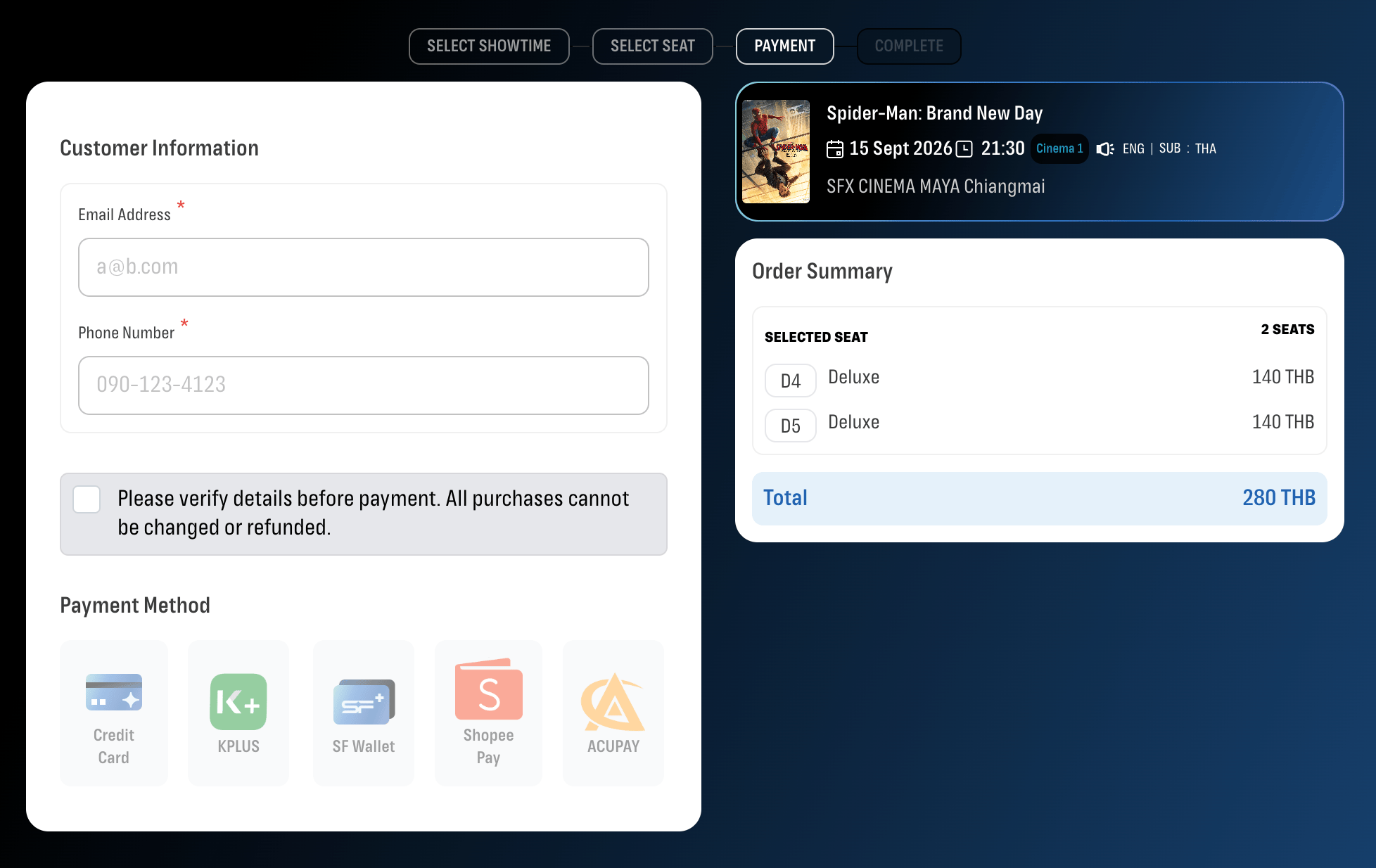
Chiang Mai is a popular nomad destination. Understandably, local cinemas screen many movies in English, with Thai subtitles. Also, we wanted to enjoy this year’s summer blockbusters with friends. So we watched Odyssey and Spider-Man: Brand New Day.
Both times we went to the SF Cinema complex in Maya Mall. It's nice that they offered a website in English. However, the Thai number requirement was absurd. Especially, because the payment with my Revolut card was successful. And the tickets were sent via email.
The required phone number field didn’t send any SMS verification. It literally accepted any number. So I put my long expired Thai number I used in 2013. So why do they ask for it anyway?
PromptPay QR payments via Touch ‘n Go and Wise
I never enjoyed carrying cash. So I'm glad that Southeast Asia leads in QR payment adoption. Thailand has its own PromptPay system that fortunately doesn’t require a local mobile number. At least when I used a 3rd party wallet like my Malaysian Touch ‘n Go. Still, I can’t wait for Wise to directly support PromptPay QR payments, as they already do in many other countries.
 Piotrek Bodera
Grab — e-hailing and food delivery in Thailand with your current number
Grab is the regional Super App. So it's no surprise that they don't require a local mobile number for verification. I set up my account with a Malaysian number once, and Grab works seamlessly everywhere I go. They automatically switch to the locally supported area offering e-hailing, food delivery, groceries, couriers, etc.
Moreover, they are tourist-friendly, so you can set up a Grab account with your current number. Even if it's from the USA, Europe, or anywhere else. The one-time password may be sent to you via SMS or WhatsApp. So it's crucial that you can still receive them while roaming.
Bolt — Estonian e-hailing app also works with your current number
The European alternative to Uber works in Chiang Mai. And most importantly, you can set it up with any mobile number. Moreover, both Grab and Bolt have built-in VoIP calling. It means that yours and the driver’s numbers are never exposed. Still, you can call each other using the app. It's the core functionality that was missing in the Indian apps during our last trip there.
LINE, WhatsApp, Instagram, Facebook for massages and restaurant reservations
The Japanese app LINE is dominant in Thailand. Yet many businesses are tourist-oriented, so they will chat with you in English via WhatsApp, Instagram, or Facebook. It's great because it works with the account you already have. Regardless of the origin of your phone number.
Once again, Beeper, the chat app aggregator is perfectly suited for this scenario. Especially, since they recently added support for LINE. This really helped me to compare rates across massage studios and book restaurant tables in advance.
Klook doesn't require a Thai mobile number for excursions
We did a few excursions around Chiang Mai. One of them was to Buatong, the sticky waterfall. Whether we booked it via Klook or directly with a local driver, we didn’t need a Thai number.
Klook, similar to Grab works with your current account. The same app allows you to search, book and pay for all activities wherever Klook operates. Once confirmed, we either used the in-app chat or reached them via WhatsApp.
 Piotrek Bodera
ASEAN becoming like the EU
I'm excited to see that the ASEAN region is mimicking the EU. In my early 20s, I remember how expensive it was to call, text, or use the mobile Internet. Now, my Polish mobile number roams seamlessly across the EU. A similar development is happening in Southeast Asia. A mobile plan from one country can work in other countries with a low roaming fee.
Then, many apps already support multinational users. Grab, Klook, Bolt, or Touch ‘n Go are the leading examples. They do it because they view it as a business opportunity.
Dear developers, please update your SMS verification requirements
When I published my article about Indian mobile problems, plenty of Indians said it's due to regulations. Yet, plenty of apps worked without an Indian number. It's the same situation in Thailand. SMS verification is a legacy authentication solution. Not a government mandate.
Yes, it's easy and common. However, it should not be the sole option. And it shouldn't be locked to a Thai number. As this cuts off many potential customers. Especially, digital nomads who enjoy slow travel, like my partner and me.
Over to you
Do you get a local phone number in every destination? Or do you rely on travel eSIMs? What are your experiences with Thai mobile requirements?
Reply and tell me what you think. I strive to respond to every comment, and I'd love hearing from you.
See you next Tuesday.


Discussion